Painless360 wants to light model aircraft like Tron. This matters because a glowing Uav lets you track models at night without killing batteries.
Small, cool-to-touch EL Wire could make night Uav wings visible and stylish without frying electronics. The idea is simple; the unknowns are EMI and brightness when embedded.
TL:DR
Painless360 bought EL Wire kits from eBay to test on a small wing. EL Wire uses a tiny inverter to generate ~90–120V at very low current. It runs cool and uses little power, but the inverter whistles and might emit EMI that can disturb GPS or flight electronics. Tests are needed before cutting any foam wings.
What is EL Wire and why it suits Uav models
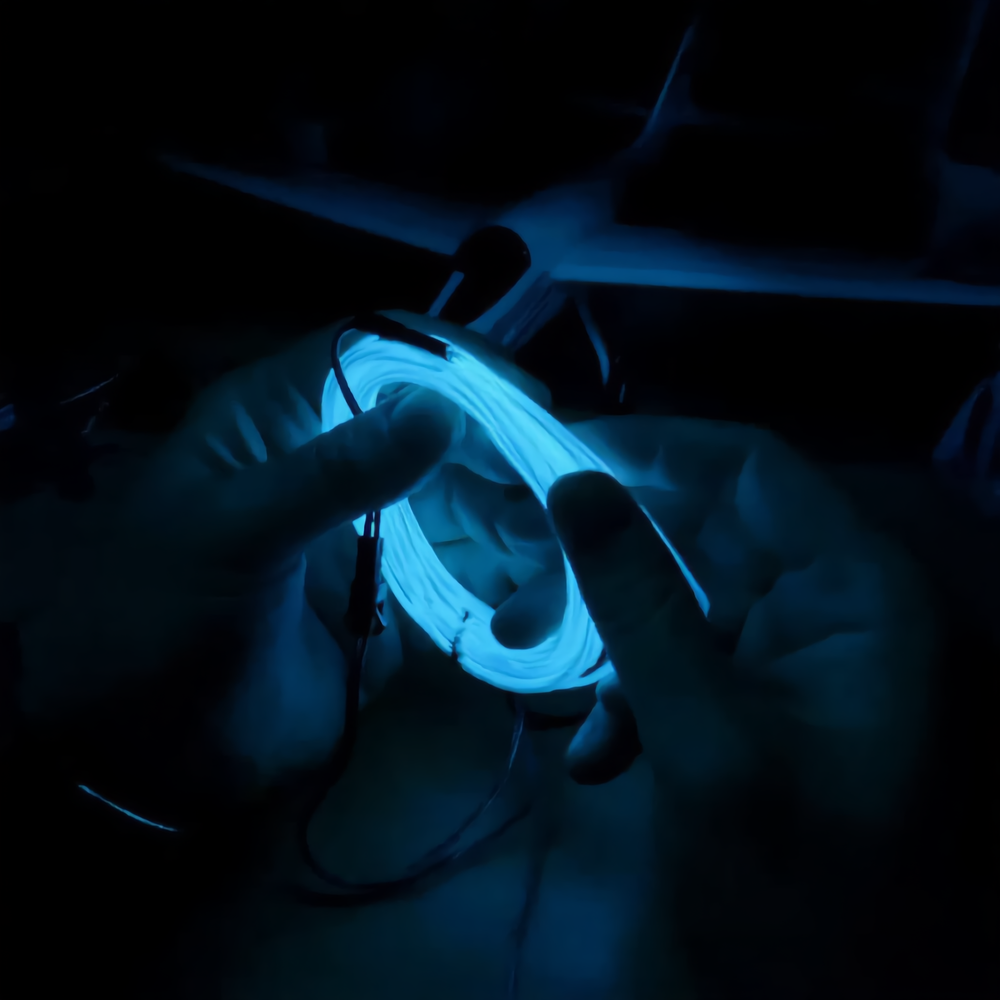
EL Wire is a plastic tube with a copper core, phosphor coating and a spiral outer conductor. A driver converts low-voltage DC to high-voltage AC and the phosphor glows. It produces lots of colours and is cool to the touch.
The low current draw makes EL Wire attractive for Uav builders. You can run metres of it from small 5V supplies and not wreck flight time. It also tolerates embedding in foam because it doesn’t get hot.
Why Painless360 wants a Tron-style wing
A Tron-style pattern on a Uav makes night flying safer and visually distinct. It also looks great in long-exposure photos—he demonstrated this with a 450-class heli covered in EL Wire.
What the kits look like and how they power up
The kits he bought include a USB-style inverter designed for 5V input. He plans to cut off the USB plug and wire the inverter to a 5V battery eliminator circuit. That keeps things neat and integrates with standard Uav power systems.
EMI, the whistle, and electronics risk
The inverter emits a high-pitched whine as it steps 5V to ~100V AC. The current is tiny, but switching noise can radiate. Painless360 is rightfully cautious about GPS and flight-controller interference.
Past experience shows RF sources near receivers can break GPS locks. Modern flight stacks are better, but the only safe path is testing—place the inverter next to GPS and flight controllers while powered and observe behaviour.
Installation tips for Uav wings
Cut EL Wire to length and seal the cut ends with hot glue to block moisture. Embed channels under foam wings and use glue to secure the wire. EL Wire stays cool, so hot glue won’t fail from heat.
Think about placement: keep the inverter as far from sensitive electronics as practical and use twisted-pair wiring or short leads to the driver. Consider an RF shield or a small metal box for the inverter if interference shows up.
Alternatives: LEDs and EL paper
3mm LED strips offer brightness and addressability, but they run warmer. EL paper gives a flat lit surface like the Tron costumes, but still needs a driver and has similar EMI traits.
For small Uav builds, EL Wire wins on weight, touch temperature and low draw. LEDs win on brightness and control. Choose based on whether you prioritise runtime, visibility, or pixel control.
Questions to answer before cutting wings
Does the inverter upset GPS or OSDs? Is embedded EL Wire visible enough in evening light? How will mounting and wiring affect crash repairs? Painless360 asks the community for tips and prior experiences.
Next steps Painless360 plans
Run bench tests: place powered inverters beside GPS modules and flight controllers. Measure signal lock and watch logs. If interference appears, test shielding and ferrites. Then trial-fit wire in a sacrificial wing for night video.
FAQ
Will EL Wire knock out my GPS on a Uav?
Possibly. The inverter switches at high voltage and can radiate. Test with the inverter powered next to your GPS and check lock and position stability.
How much power does EL Wire use on a typical Uav?
Very little. EL Wire draws microamps to low milliamps per metre at the inverter output. The USB-style inverter draws only a fraction of what lights or motors consume, so it’s battery-friendly for Uav night flights.
Can I embed EL Wire in foam wings safely?
Yes. EL Wire stays cool and tolerates hot glue. Seal cut ends to stop moisture and glue channels to prevent movement during crashes.
Are LEDs better than EL Wire for night Uav lighting?
Depends. LEDs provide more brightness and control but run warmer and draw more power. EL Wire is low-drain, cool, and simple. Use LEDs for visible signalling, EL Wire for aesthetic outlines and long runtime.
Takeaway
Painless360’s plan is sensible: test before you cut. EL Wire is a low-weight, low-heat option for Uav night lighting. But bench-test for EMI and GPS impact first.
Quick bites for the skim reader
- EL Wire lights by a phosphor coat and needs a small inverter — low current, some EMI.
- Embed in foam: safe because it stays cool; seal cut ends with hot glue.
- Test inverter near GPS and flight controller before final installation.
- LEDs beat EL Wire on brightness; EL Wire wins on runtime and touch temperature.
Takeaway box
- Uav night visibility without heavy battery drain: EL Wire is practical and light.
- Run an inverter bench test beside GPS and FC before you install it.
- Seal cut EL Wire with hot glue and keep the inverter away from antennas.
- If you need pixels or raw brightness, choose LEDs instead of EL Wire.
This article was based from the video I've had an idea for a TRON style night flying wing/plane. Have you used EL Wire with modern stuff?