A practical guide to choosing the right Operational Authorisation pathway for your UK drone operations.
If you're planning commercial drone work in the UK that goes beyond basic hobbyist flights, you'll eventually hit the same question: PDRA01 or UK SORA?
Both are pathways to get Operational Authorisation from the Civil Aviation Authority (CAA) for operations in the Specific Category. But they serve very different needs, and picking the wrong one can cost you time, money, and missed opportunities.
This guide breaks down what each pathway offers, who it's for, and how to choose.
The Quick Answer
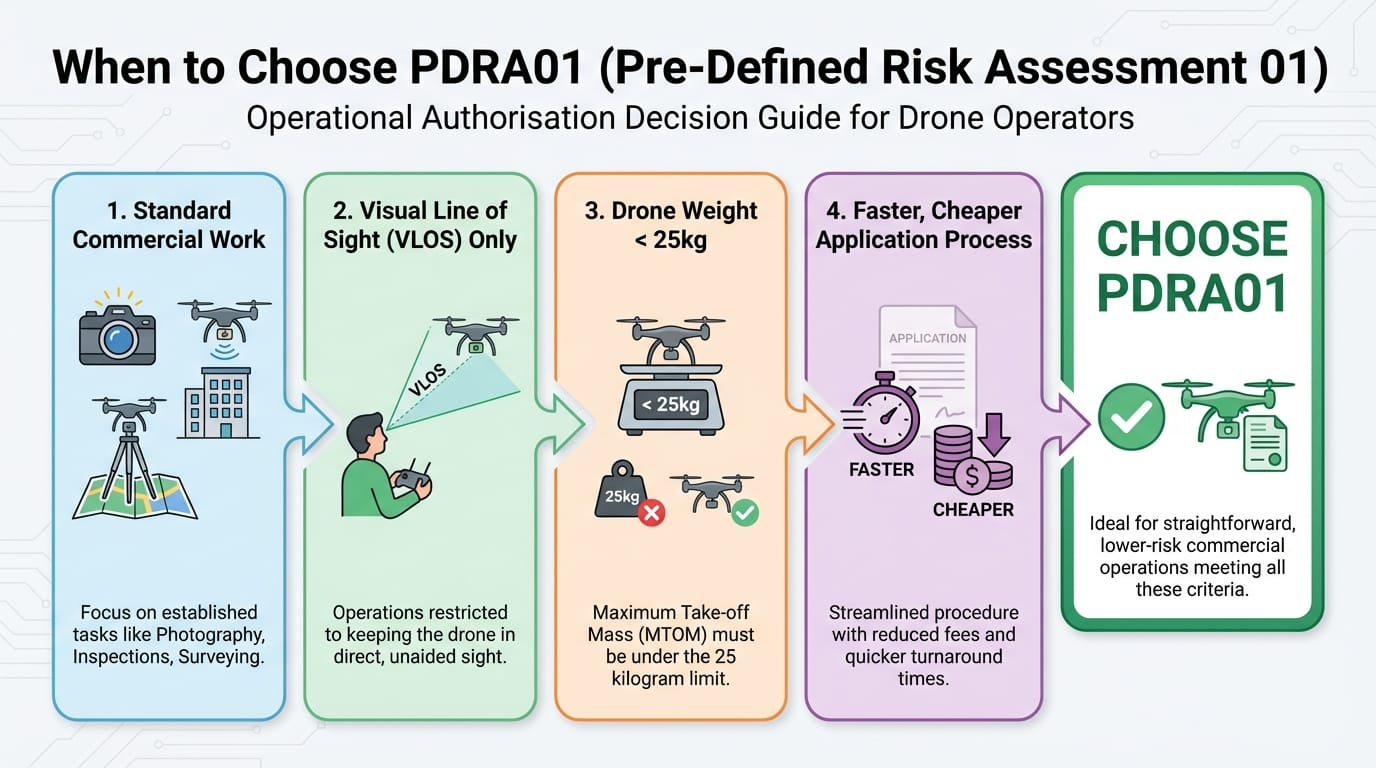
Choose PDRA01 if:
- You're doing standard commercial work (inspections, photography, surveying)
- You only need Visual Line of Sight (VLOS) operations
- Your drone weighs under 25kg
- You want a faster, cheaper application process
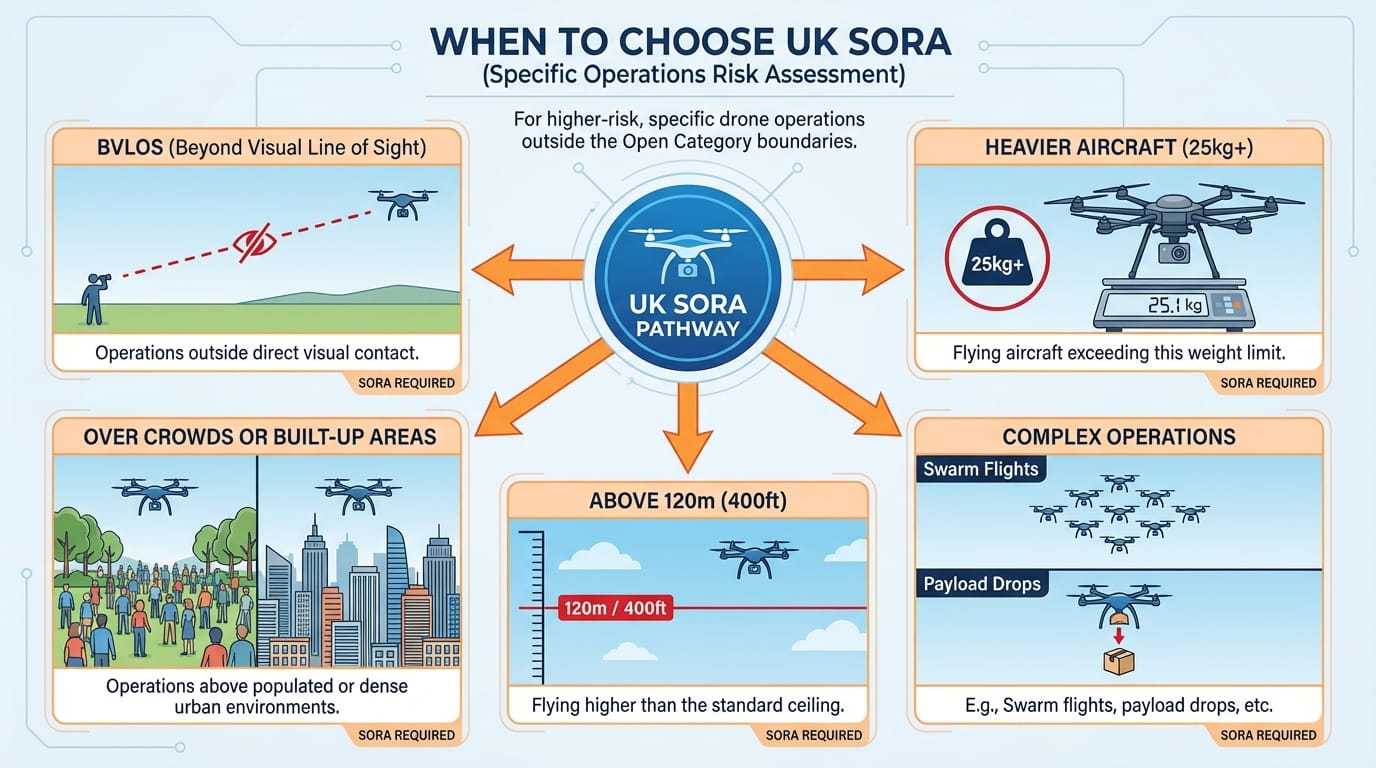
Choose UK SORA if:
- You need Beyond Visual Line of Sight (BVLOS) operations
- You're flying heavier aircraft (25kg+)
- You need to fly over crowds or built-up areas
- You're doing complex operations like swarm flights or payload drops
- You need to fly above 120m (400ft)
Understanding the UK Drone Framework
Before diving into the specifics, it helps to understand where these pathways fit.
The Three Categories
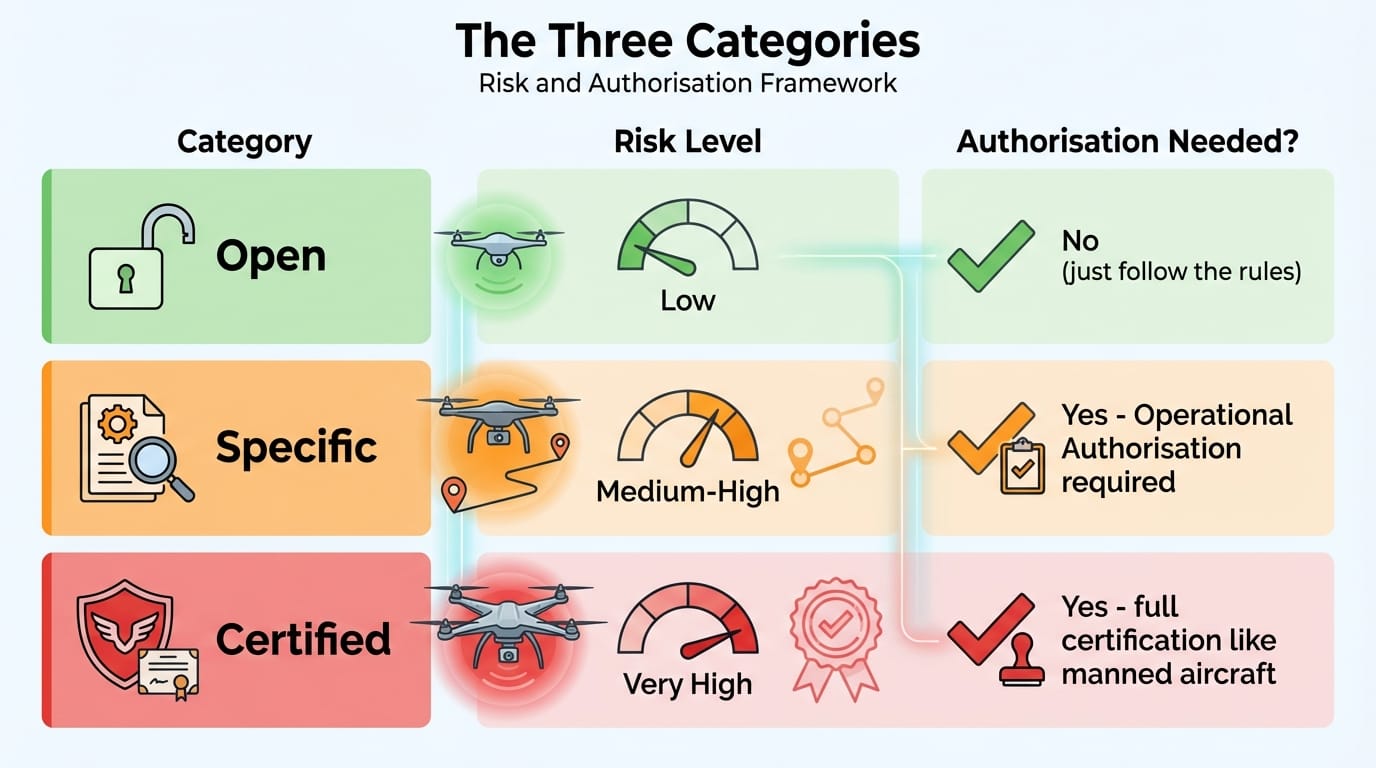
The CAA divides drone operations into three categories based on risk:
| Category | Risk Level | Authorisation Needed? |
|---|---|---|
| Open | Low | No (just follow the rules) |
| Specific | Medium-High | Yes - Operational Authorisation required |
| Certified | Very High | Yes - full certification like manned aircraft |
Most commercial operations fall into the Specific Category. That's where PDRA01 and UK SORA come in.
What is Operational Authorisation?
Think of it as permission from the CAA to conduct operations that would otherwise be illegal under Open Category rules. It proves you've assessed the risks and put safety measures in place.
PDRA01: The Standard Pathway
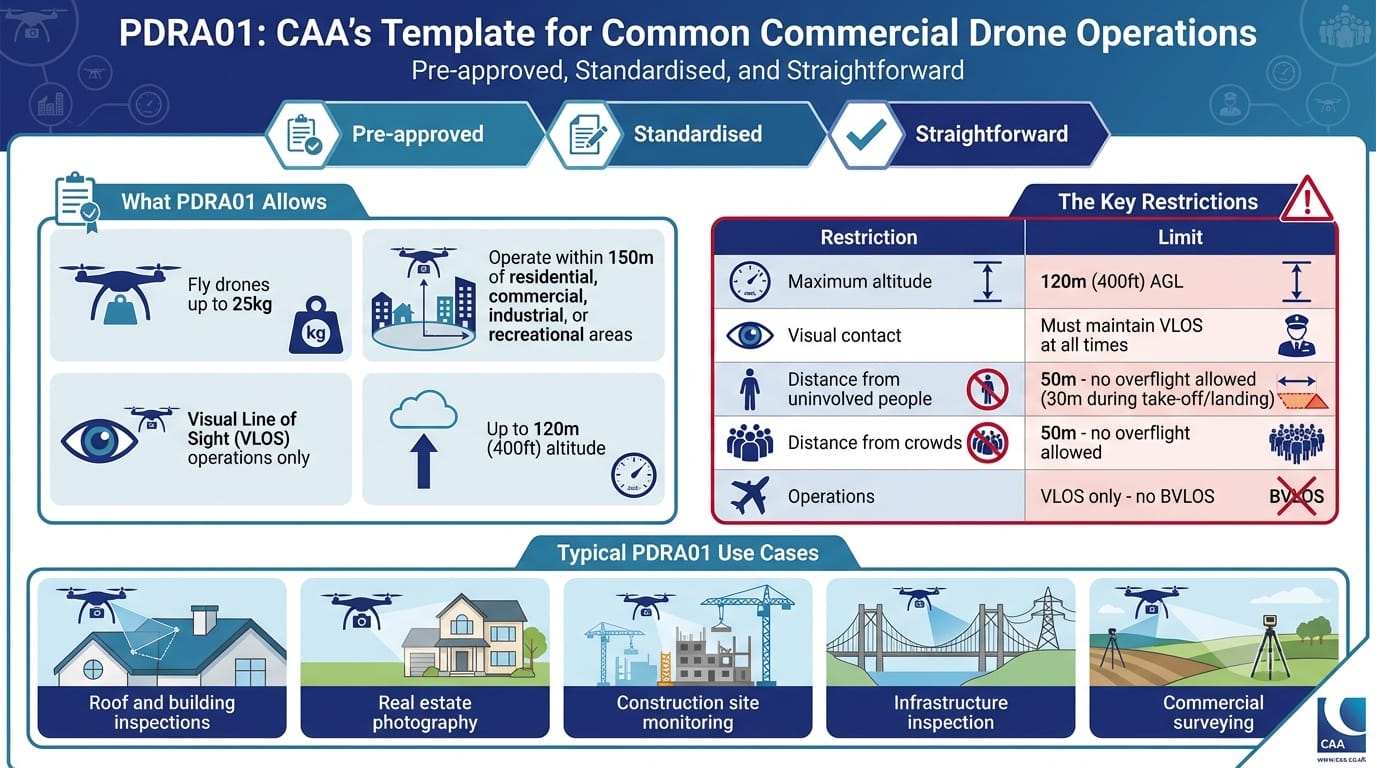
PDRA01 (Pre-Defined Risk Assessment 01) is the CAA's template for common commercial drone operations. It's pre-approved, standardised, and designed to be straightforward.
What PDRA01 Allows
- Fly drones up to 25kg
- Operate within 150m of residential, commercial, industrial, or recreational areas
- Visual Line of Sight (VLOS) operations only
- Up to 120m (400ft) altitude
The Key Restrictions
| Restriction | Limit |
|---|---|
| Maximum altitude | 120m (400ft) AGL |
| Visual contact | Must maintain VLOS at all times |
| Distance from uninvolved people | 50m horizontal (30m during take-off/landing) |
| Distance from crowds | 50m - no overflight allowed |
| Operations | VLOS only - no BVLOS |
Typical PDRA01 Use Cases
- Roof and building inspections
- Real estate photography
- Construction site monitoring
- Infrastructure inspection
- Commercial surveying
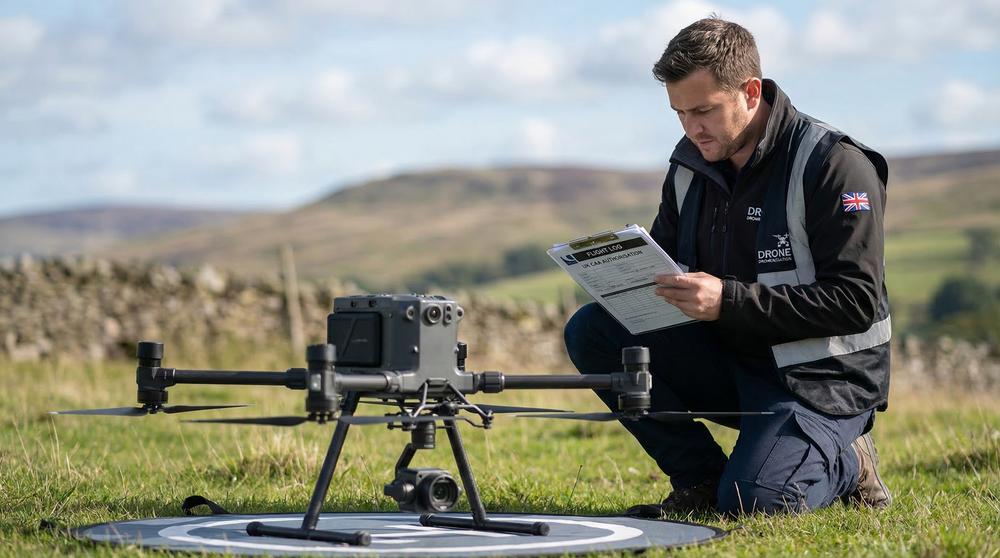
Basically, if you're standing there watching your drone while it inspects a roof or captures footage, PDRA01 is probably your lane.
What You Need for PDRA01
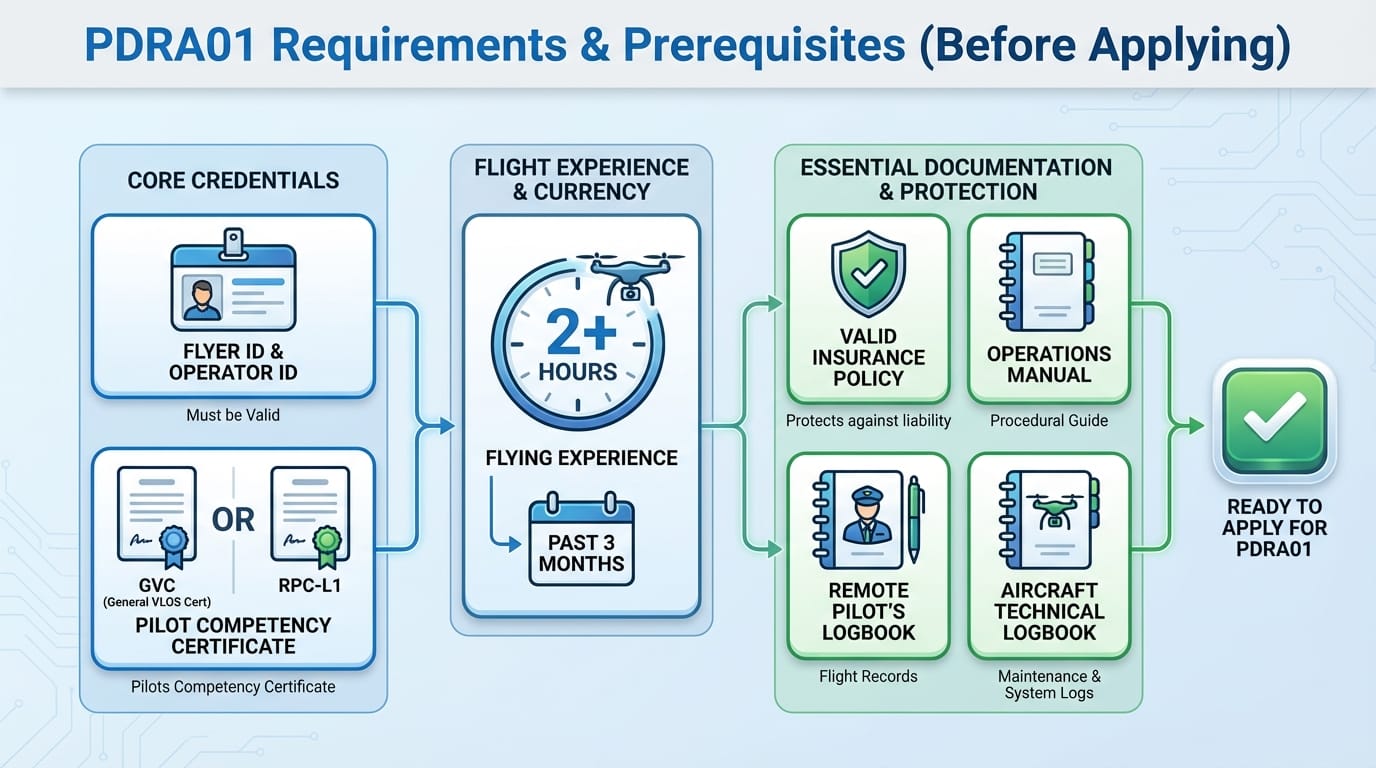
Before applying, you'll need:
- Valid Flyer ID and Operator ID
- GVC (General Visual Line of Sight Certificate) or RPC-L1
- At least 2 hours flying experience in the past 3 months
- Valid insurance
- Operations Manual
- Remote Pilot's Logbook
- Aircraft technical logbook
UK SORA: The Advanced Pathway
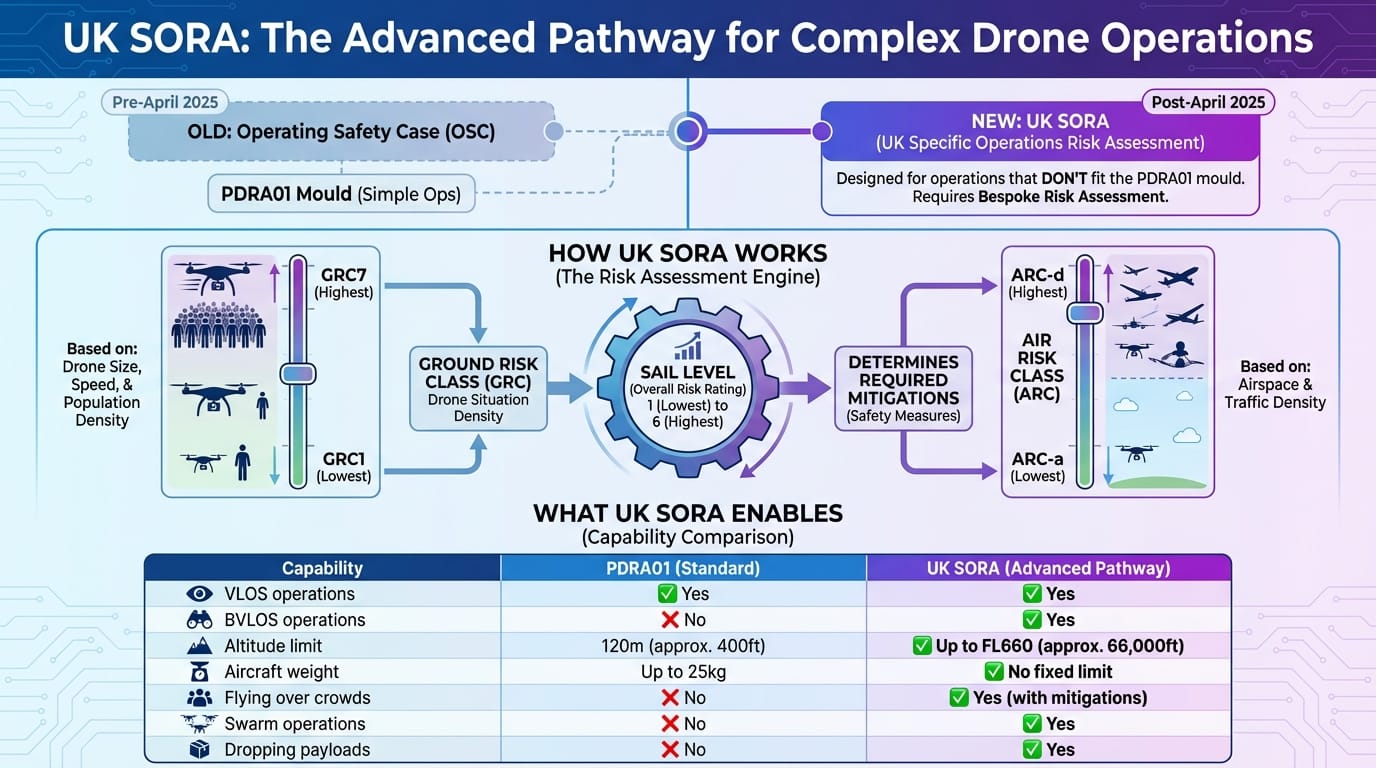
UK SORA (UK Specific Operations Risk Assessment) replaced the old Operating Safety Case (OSC) system in April 2025. It's designed for operations that don't fit the PDRA01 mould.
How UK SORA Works
Instead of a pre-defined template, UK SORA requires a bespoke risk assessment based on:
Ground Risk Class (GRC) - Risk to people on the ground
- Ranges from GRC1 (lowest) to GRC7 (highest)
- Based on drone size, speed, and population density
Air Risk Class (ARC) - Risk of mid-air collision
- Ranges from ARC-a (lowest) to ARC-d (highest)
- Based on airspace and traffic density
SAIL Level - Overall risk rating
- Combines GRC and ARC
- Ranges from 1 (lowest risk) to 6 (highest risk)
- Determines what mitigations you need
What UK SORA Enables
| Capability | PDRA01 | UK SORA |
|---|---|---|
| VLOS operations | Yes | Yes |
| BVLOS operations | No | Yes |
| Altitude limit | 120m | Up to FL660 |
| Aircraft weight | Up to 25kg | No fixed limit |
| Flying over crowds | No | Yes (with mitigations) |
| Swarm operations | No | Yes |
| Dropping payloads | No | Yes |
When You Need UK SORA
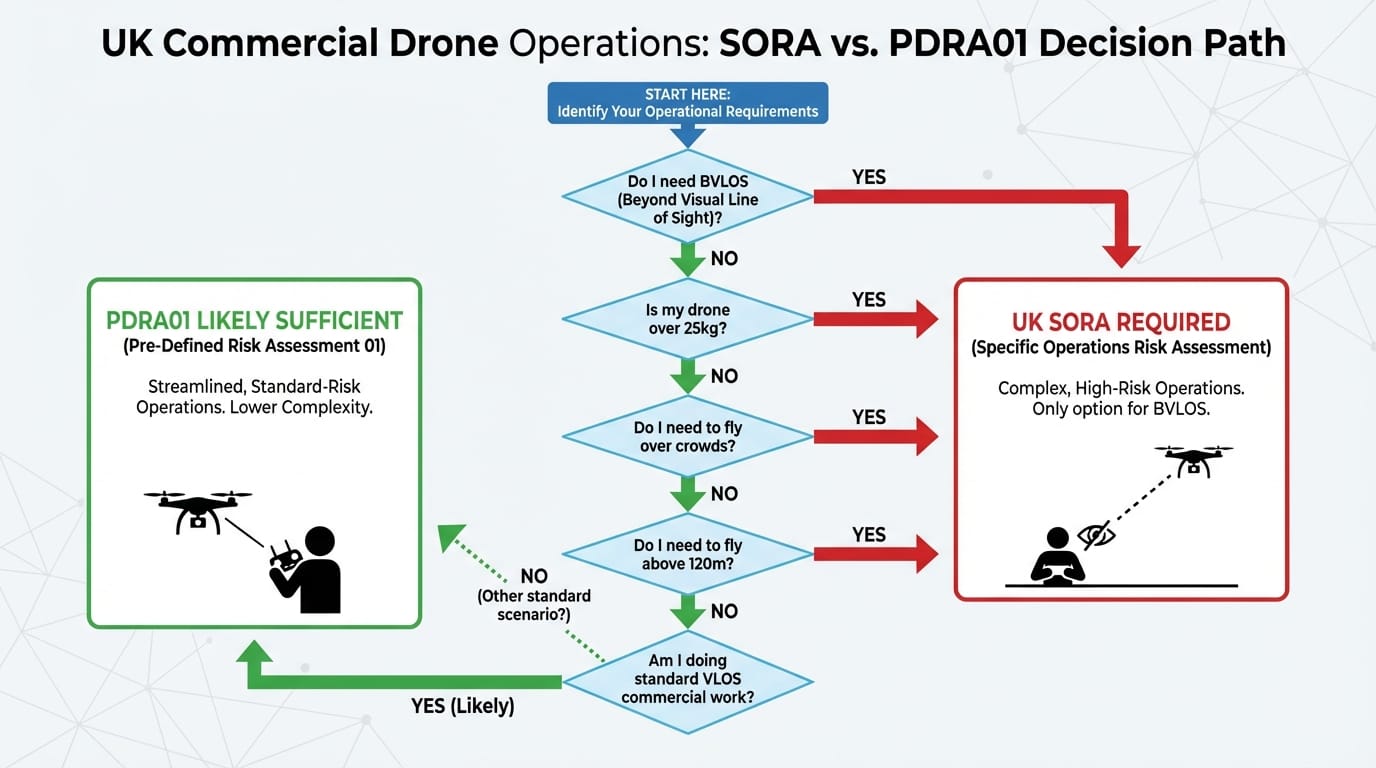
- BVLOS operations - Flying beyond visual range (increasingly common for infrastructure inspection, surveying, and delivery)
- Heavier aircraft - Drones over 25kg, including heavy-lift platforms
- Crowd operations - Flying over or near assemblies of people
- High-altitude work - Above 120m
- Complex missions - Swarm flights, payload drops, or non-standard operations
UK SORA Limitations
Even UK SORA has boundaries:
- Aircraft larger than 40m (unlikely for most commercial operations)
- Cruise speeds above 200m/s
- Operations above Flight Level 660
- Large/fast aircraft in densely populated areas (>50,000 people/km²)
Side-by-Side Comparison
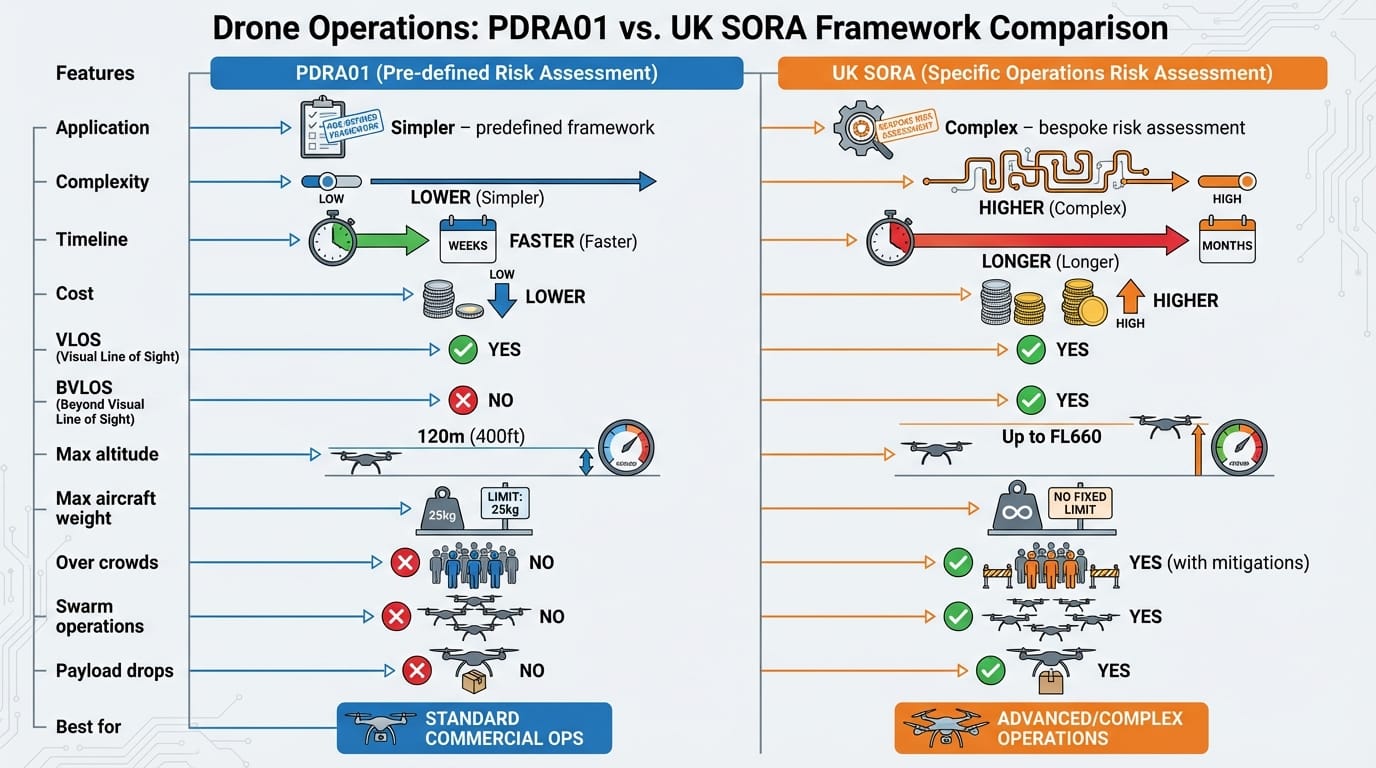
| Feature | PDRA01 | UK SORA |
|---|---|---|
| Application complexity | Simpler - predefined framework | Complex - bespoke risk assessment |
| Timeline | Faster | Longer |
| Cost | Lower | Higher |
| VLOS | Yes | Yes |
| BVLOS | No | Yes |
| Max altitude | 120m (400ft) | Up to FL660 |
| Max aircraft weight | 25kg | No fixed limit |
| Over crowds | No | Yes (with mitigations) |
| Swarm operations | No | Yes |
| Payload drops | No | Yes |
| Best for | Standard commercial ops | Advanced/complex operations |
How to Choose
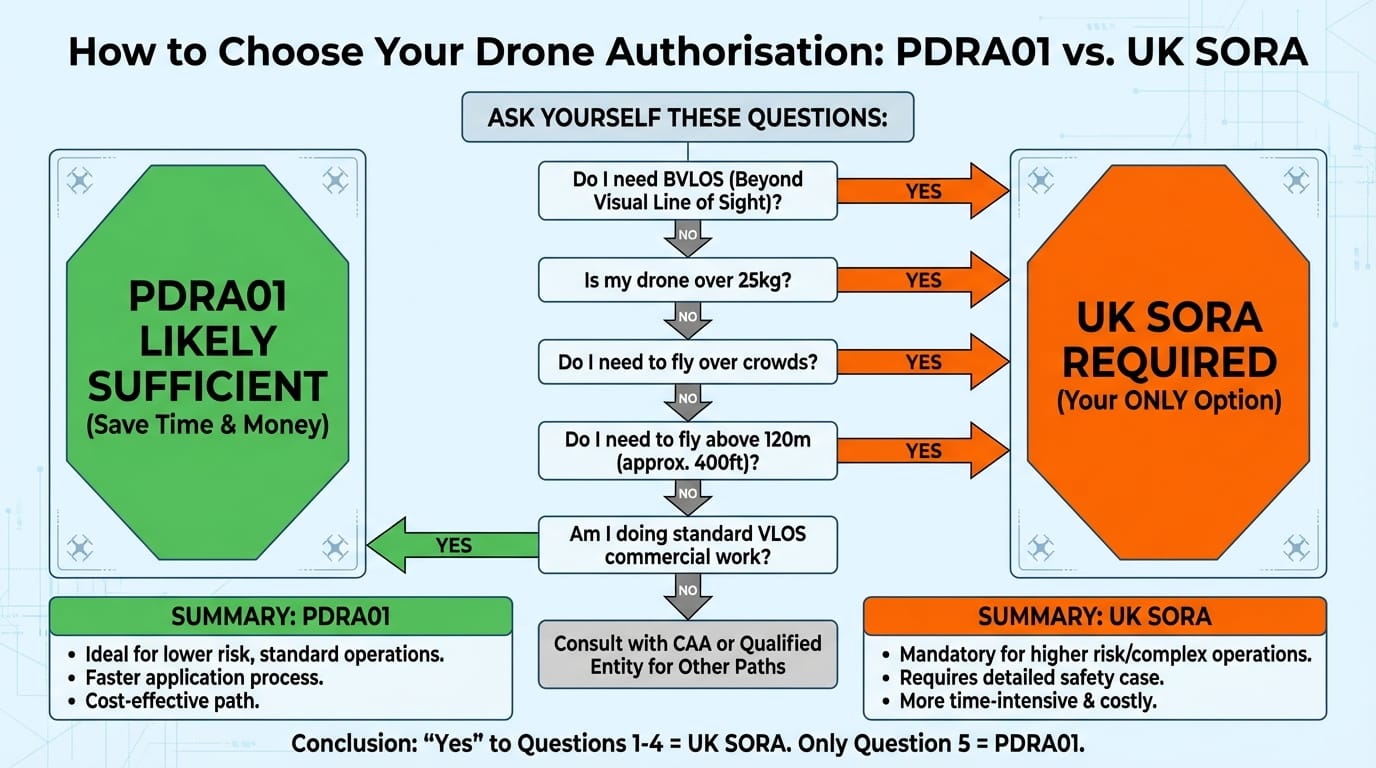
Ask yourself these questions:
- Do I need BVLOS? If yes, UK SORA is your only option.
- Is my drone over 25kg? UK SORA required.
- Do I need to fly over crowds? UK SORA required.
- Do I need to fly above 120m? UK SORA required.
- Am I doing standard VLOS commercial work? PDRA01 is likely sufficient.
If you answered "yes" to questions 1-4, you need UK SORA. If only question 5 applies, PDRA01 will save you time and money.
Getting Started
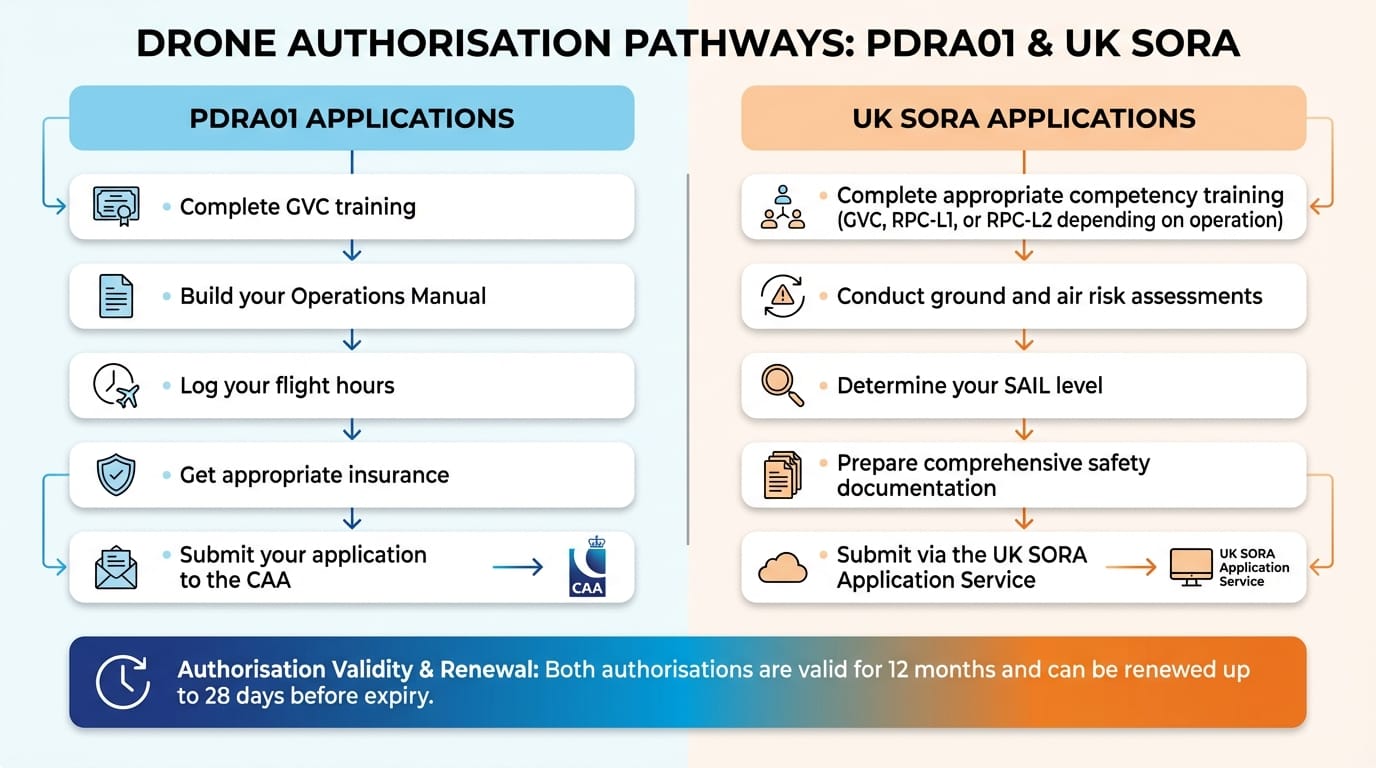
For PDRA01 Applications
- Complete GVC training
- Build your Operations Manual
- Log your flight hours
- Get appropriate insurance
- Submit your application to the CAA
For UK SORA Applications
- Complete appropriate competency training (GVC, RPC-L1, or RPC-L2 depending on operation)
- Conduct ground and air risk assessments
- Determine your SAIL level
- Prepare comprehensive safety documentation
- Submit via the UK SORA Application Service
Both authorisations are valid for 12 months and can be renewed up to 28 days before expiry.
Bottom Line
PDRA01 is your fast-track for standard commercial drone work. It's cheaper, quicker, and covers most inspection, photography, and surveying jobs.
UK SORA is your pathway to advanced operations. It costs more and takes longer, but unlocks BVLOS, heavy-lift, crowd overflight, and other capabilities that PDRA01 can't touch.
Choose based on what you actually need to do - not what you think you might need someday. You can always upgrade to UK SORA later if your operations evolve.
Need help navigating the authorisation process? Get in touch with us at unmanned tech and we can point you in the right direction.