Prop wash is not just “turbulence happens” with a shrug attached. It is a very specific aerodynamic failure mode, and once that is understood, the fixes stop looking like folk magic.
TLDR: What you actually need to know
- Prop wash happens when a propeller enters reverse flow and the upper surface stalls, which makes thrust change wildly over a very small RPM range.
- The top surface of the blade matters more than many pilots assume, and in Chris Rosser’s explanation it contributes roughly 70% of the thrust when the flow is attached.
- Lower pitch props handle prop wash better because they recover attached flow at lower RPM and produce a smaller thrust jump during recovery.
- Betaflight Dynamic Idle can help a lot by keeping motor RPM above the nasty transition zone. On a 5 inch quad, a typical value is around 20 to 40, which corresponds to 2000 to 4000 RPM.
- Best for: pilots chasing smoother footage, especially on 5 inch and smaller quads that see steep dives or hard pylon-style reversals.
- Avoid if: the goal is maximum bite from aggressive high pitch props at all costs, and some float at zero throttle is unacceptable.
What is prop wash really?
Prop wash is a control problem caused by a propeller recovering from reverse flow, not just a quad flying through messy air. The messy air is part of the setup, but the real drama starts when airflow over the blade detaches and then snaps back into place over a narrow RPM window.
That is why the quad can feel fine one moment, then wobble and argue with the pilot the instant throttle is applied after a dive. The flight controller asks for a bit more thrust, the propeller delivers far more than expected, and the correction overshoots. Then another motor does the same. Then the quad starts impersonating a washing machine.
So the useful takeaway is this. Prop wash is not random. It comes from a repeatable aerodynamic transition.
Why is the usual lift explanation not enough?
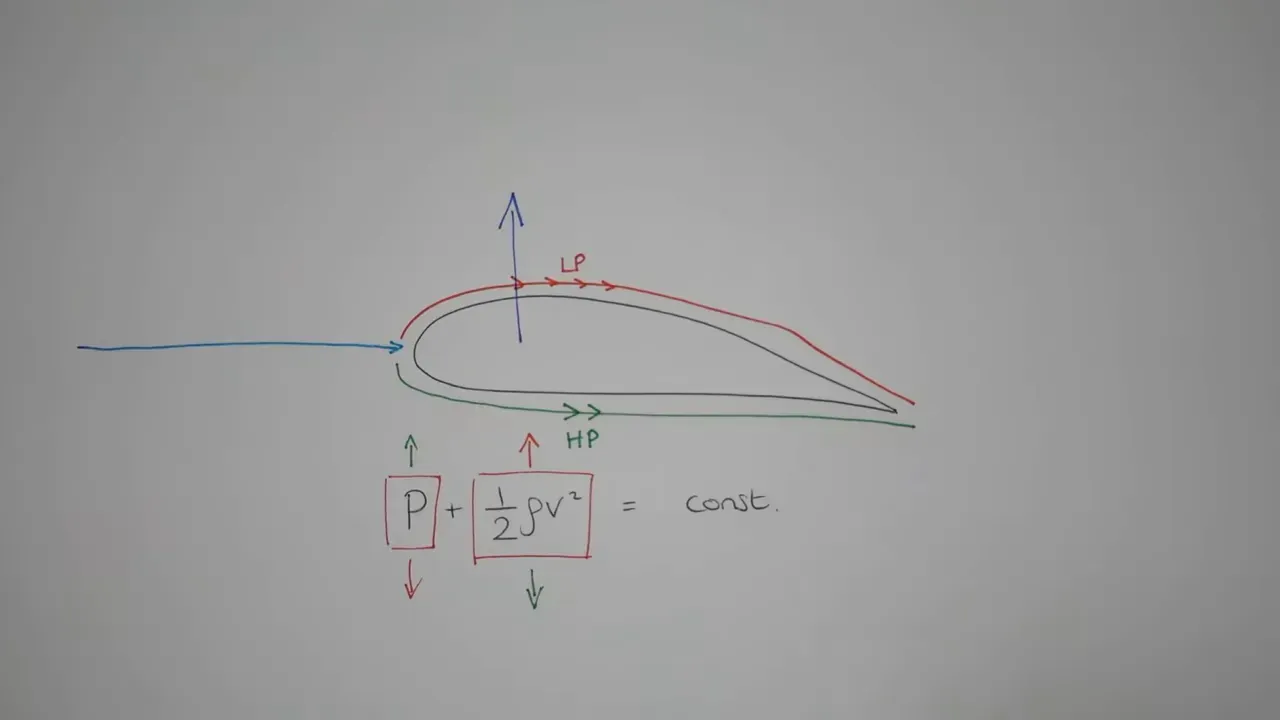
The usual schoolbook story is incomplete. The familiar version says air splits at the leading edge, the air over the top takes a longer path, moves faster, pressure drops, and lift appears as if by educational poster.
That story is tidy, but it falls apart when applied too literally. Symmetrical aerofoils can still generate lift, even though the path lengths above and below are the same. More awkwardly, if lift depended on a pristine streamline over the top surface in the simplistic way often taught, any disturbance would kill lift entirely and recovery from prop wash would be hopeless. It plainly is not.
The better way to think about it is that the blade generates thrust by turning airflow downward. Pressure differences matter, but they are part of how the air is forced to curve, not the original cause in the fairy tale sense.
How does a propeller actually make thrust?
A propeller makes thrust by pushing air downward, and the equal and opposite reaction pushes the blade upward. Newton still works, which is mildly annoying for anyone hoping for a more glamorous answer.
The missing piece is how the airflow stays attached to the top of the blade. On the lower surface, it is easy to picture. The air hits the blade and has to turn. On the upper surface, it looks less obvious because there is no solid wall above forcing it down.
The answer is pressure. If the flow tried to leave the upper surface and continue straight on, it would leave a low-pressure region behind. Surrounding air pushes in, which keeps the airflow conforming to the surface. As that flow curves, a pressure difference forms across the curve, with higher pressure on the outside and lower pressure on the inside. That pressure pattern is what bends the air, and the resulting pressure difference across the blade is what creates thrust.
So the speed increase over the top surface is more symptom than root cause. The low pressure comes first because the flow is curving. The higher speed follows from that pressure field.
What does CFD show in normal flight?
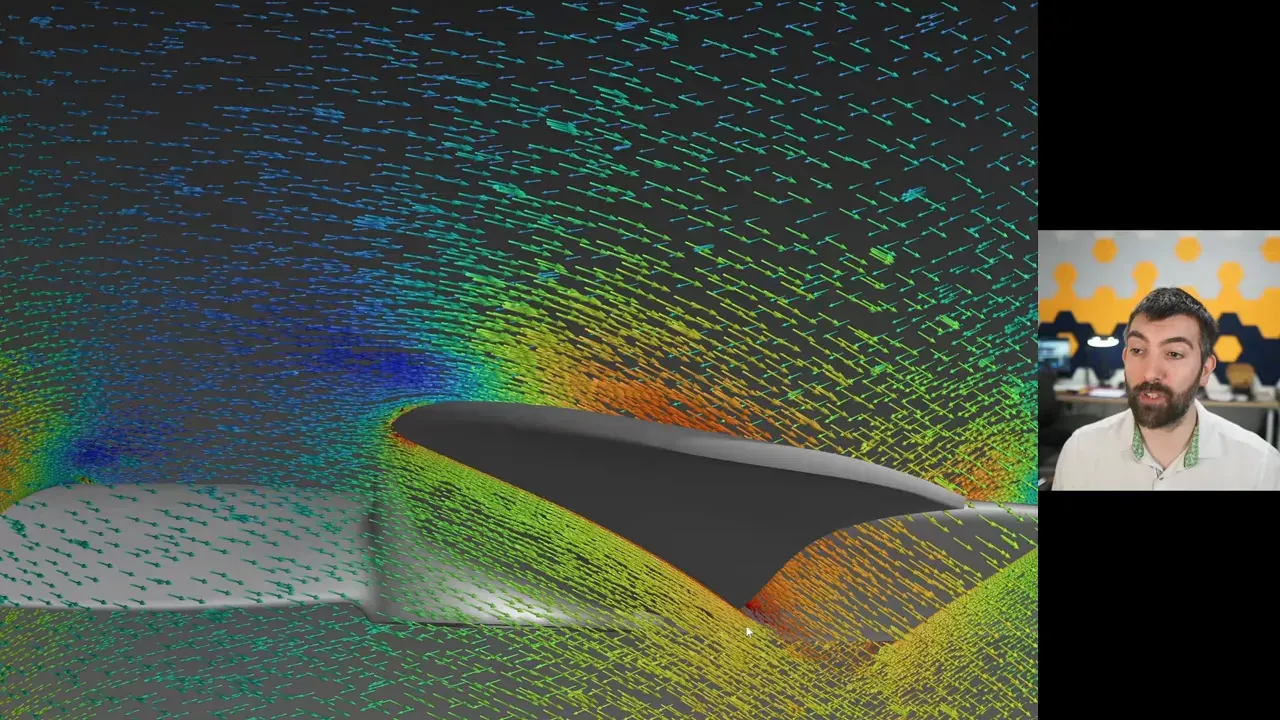
In normal flow, the CFD looks exactly like a healthy propeller should. Air approaches the blade, follows both surfaces, and exits with a strong downward deflection.
The important detail is that the upper surface shows stronger flow curvature than the lower surface. That means the top of the blade is doing most of the aerodynamic heavy lifting. This matters later, because when that upper surface stalls, the prop loses the majority of the thrust contribution that makes it behave nicely.
In other words, the propeller is not merely chopping air. It is managing a fairly precise pressure and curvature pattern, right up until reverse flow barges in and ruins the evening.
What happens to an FPV propeller in reverse flow?
In reverse flow, the propeller briefly stops acting like a propeller and starts acting more like a parachute. That is the ugly bit.
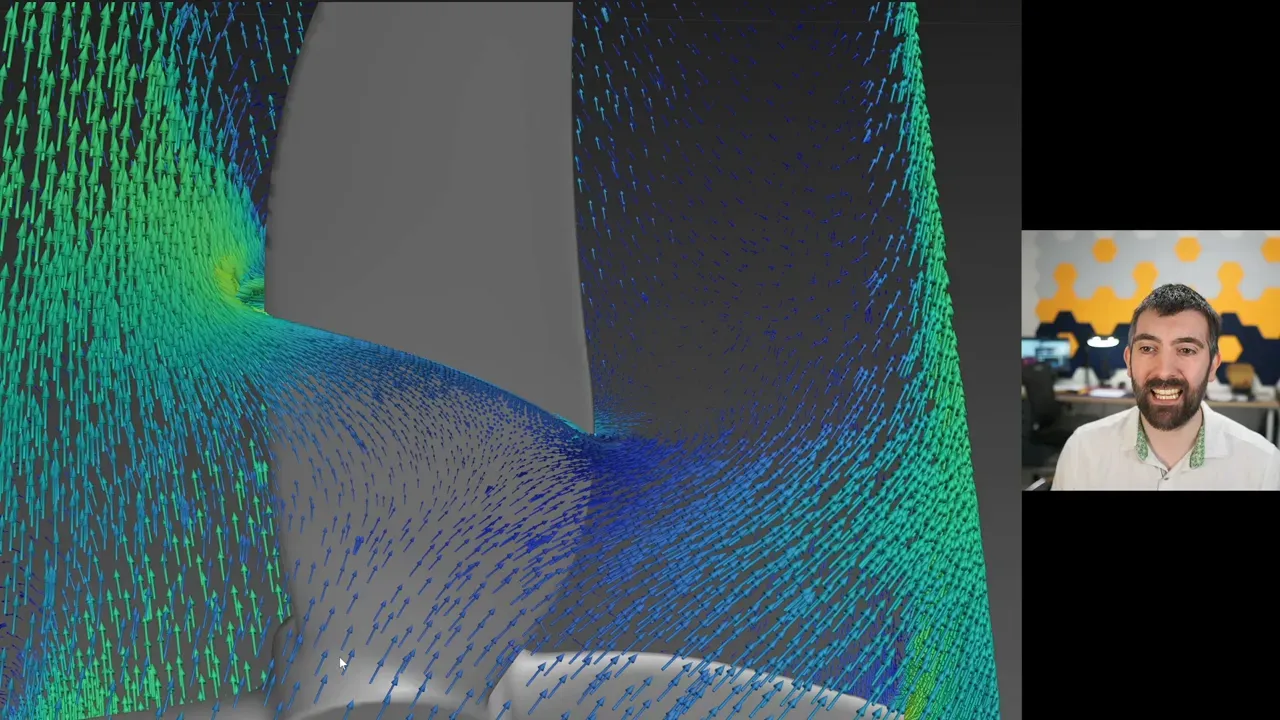
When the quad drops into a steep dive, or the airflow rushes upward into the props during a sharp manoeuvre, the blade can see air arriving from underneath. At low RPM, the flow hits the underside, spills around both sides, and a large recirculation region forms over the top surface.
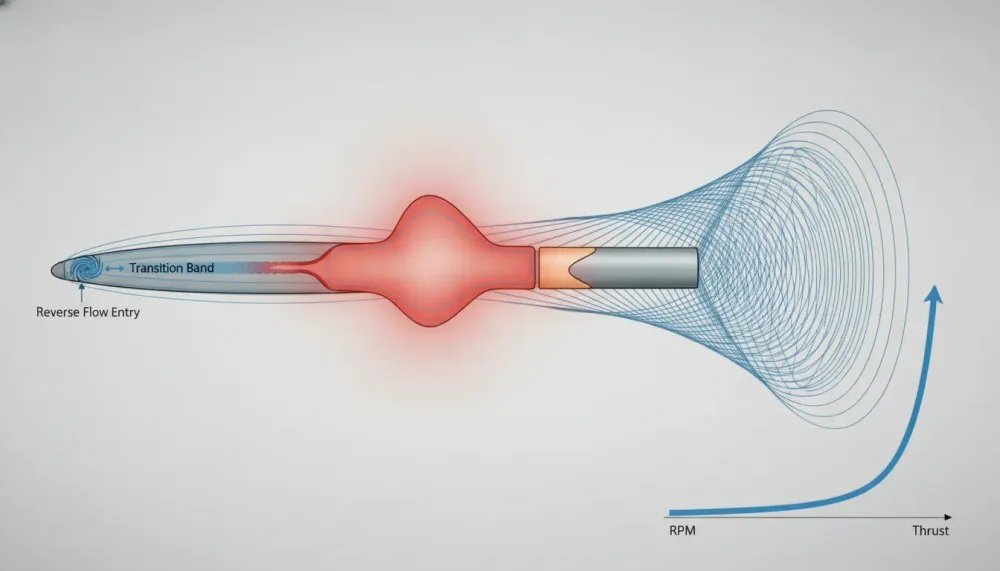
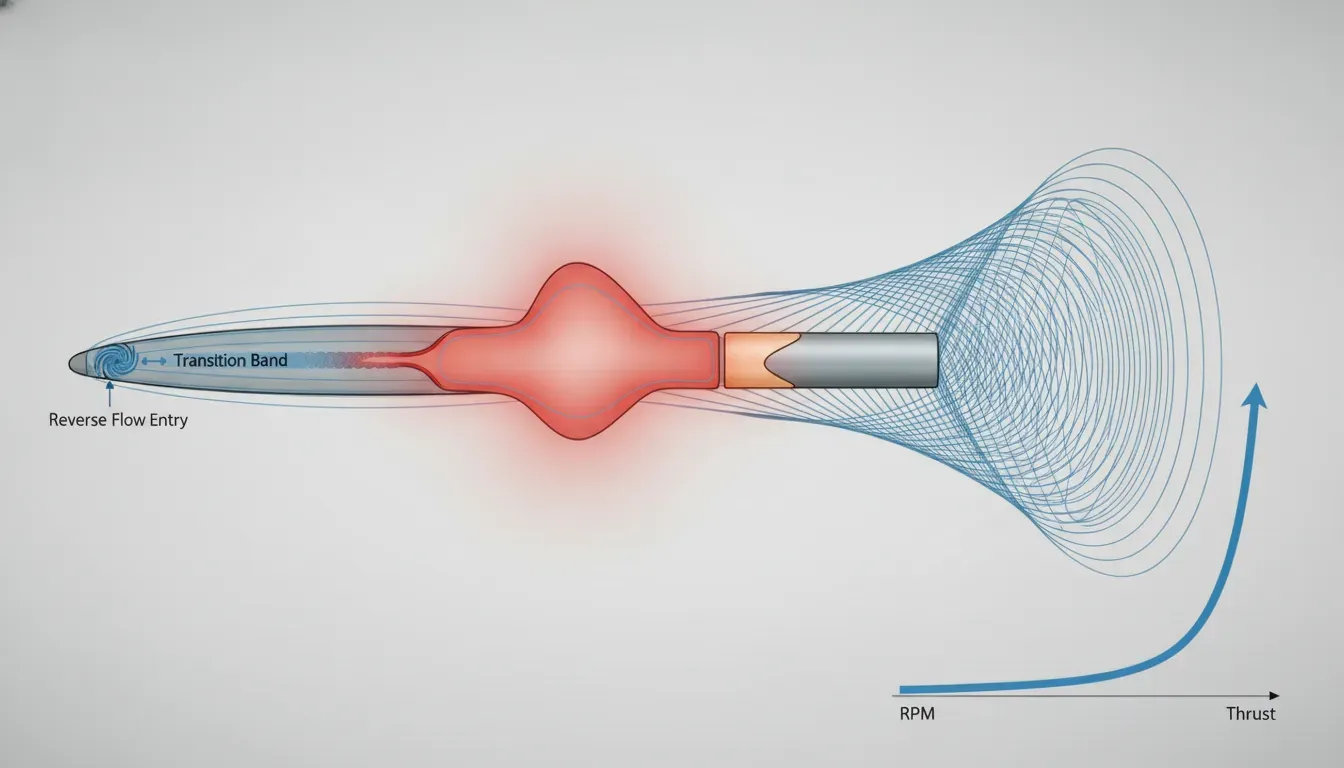
That recirculation region is the real villain. Instead of smooth attached flow over the upper surface, there is a disordered swirling bubble. No attached flow means no meaningful curvature over that surface. No curvature means the top surface is not making its normal share of thrust.
So at that point the prop is not producing thrust in the neat linear way the flight controller would dearly love. It is in a stalled, partially useless state.
How does a prop recover from prop wash?
A prop recovers by shrinking that recirculation bubble as RPM rises. The recovery does not happen everywhere at once, which is where things get interesting.
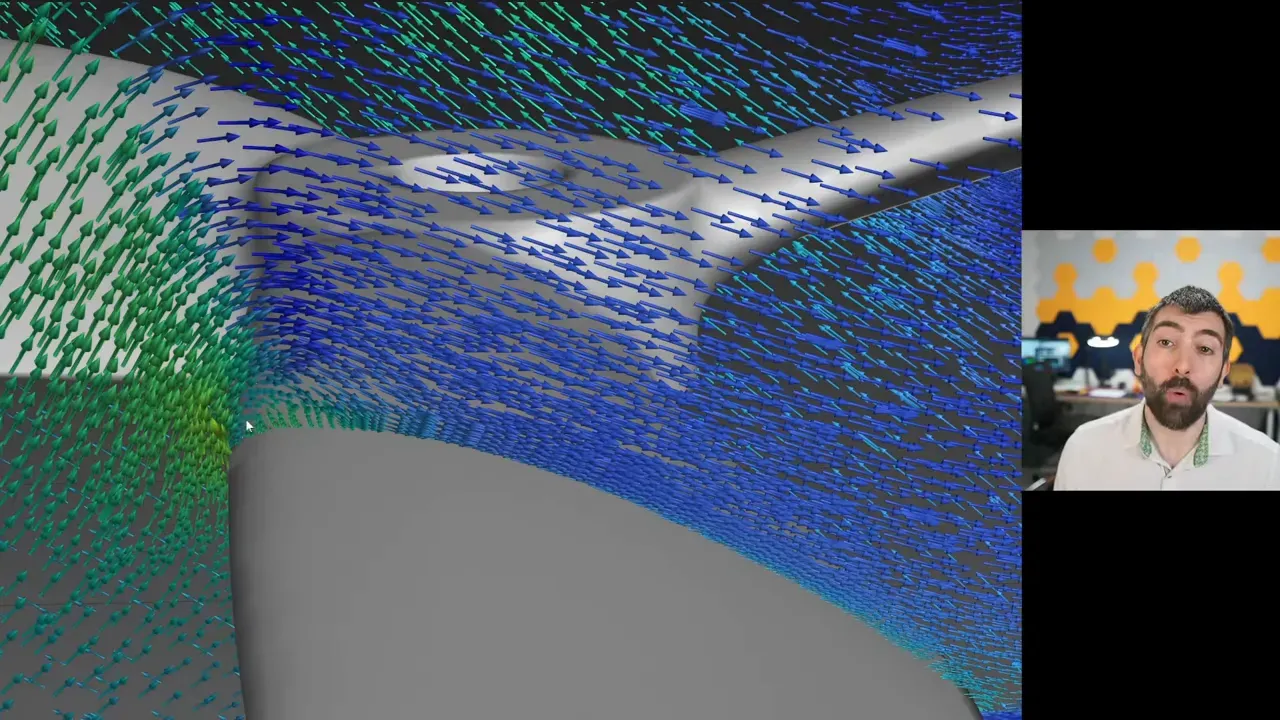
At slightly higher RPM, the big recirculation region retreats toward the leading edge. That sounds encouraging, but it still wrecks the upper-surface flow enough to prevent proper thrust generation there. Increase RPM further, and the attached flow starts to return over more of the blade.
The clever detail from the CFD is that recovery starts near the tip first. The outer part of the blade is moving faster, so it can support attached flow earlier. That attached tip region creates lower pressure, which drags low-energy air spanwise toward the tip. Chris Rosser describes this as a kind of centrifugal pumping effect. It helps re-energise the boundary layer and encourages the stalled region further inboard to reattach as RPM climbs.
This tip-first recovery is not the sort of detail that shows up in the usual “prop wash is turbulence” explanation. It matters because it shows the transition is structured, not random.
Why does prop wash cause oscillation?
Prop wash oscillation happens because thrust changes too much for too little RPM change. The flight controller makes a small correction, but the propeller responds like it has been personally insulted.
If one corner of the quad drops, the controller raises RPM on that motor. If that tiny RPM increase happens to push the blade out of its stalled upper-surface condition, the prop suddenly regains a large chunk of thrust. In Chris Rosser’s explanation, the upper surface contributes about 70% of prop thrust when attached, so that transition is not subtle.
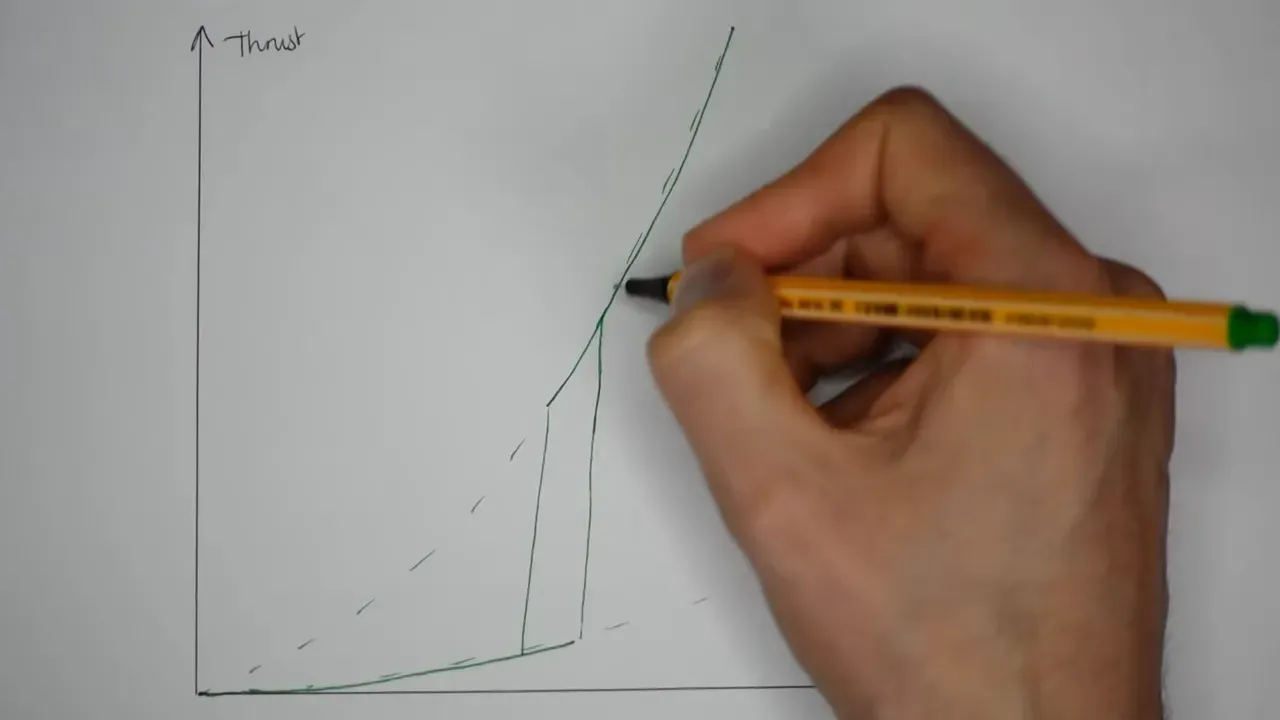
The result is an overshoot. The quad gets kicked too hard, the controller reacts by adjusting other motors, those motors also cross the transition, and now the whole system chases its own tail. Add reverse flow and a narrow transition band, and the control loop starts fighting an aerodynamic step change instead of a smooth thrust curve.
So the wobble is not because the PID loop forgot its job. It is because the propeller stopped behaving like a roughly predictable actuator.
Which prop pitch is best for reducing prop wash?
Lower pitch props are better for reducing prop wash. That is the clearest recommendation in the material, and it is backed by the thrust-versus-RPM reasoning.
A medium or high pitch prop has a larger gap between stalled thrust and fully attached thrust, and that gap appears at a higher RPM. The transition region is therefore bigger and nastier for the flight controller. A shallow pitch prop recovers attached flow at lower RPM because the blade demands less curvature from the airflow. It is simply easier for the flow to stay attached.
That gives two benefits:
- The prop transitions out of stall earlier as throttle rises.
- The jump in thrust across that transition is smaller.
There is a third benefit too. Lower pitch props let the pilot run a higher Dynamic Idle without making the quad feel absurdly floaty at zero throttle. That matters because Dynamic Idle is the other main tool for reducing prop wash.
So if smooth recovery matters more than headline punch, lower pitch is the sane choice. High pitch can still be fun, of course. So can hammering nails in with a ceramic mug.
How does Betaflight Dynamic Idle fix prop wash?
Dynamic Idle helps by keeping motor RPM above the ugly stalled-to-attached transition zone. If the motors never spin down into that region, the prop is less likely to surprise the flight controller with a huge thrust step on throttle reapplication.
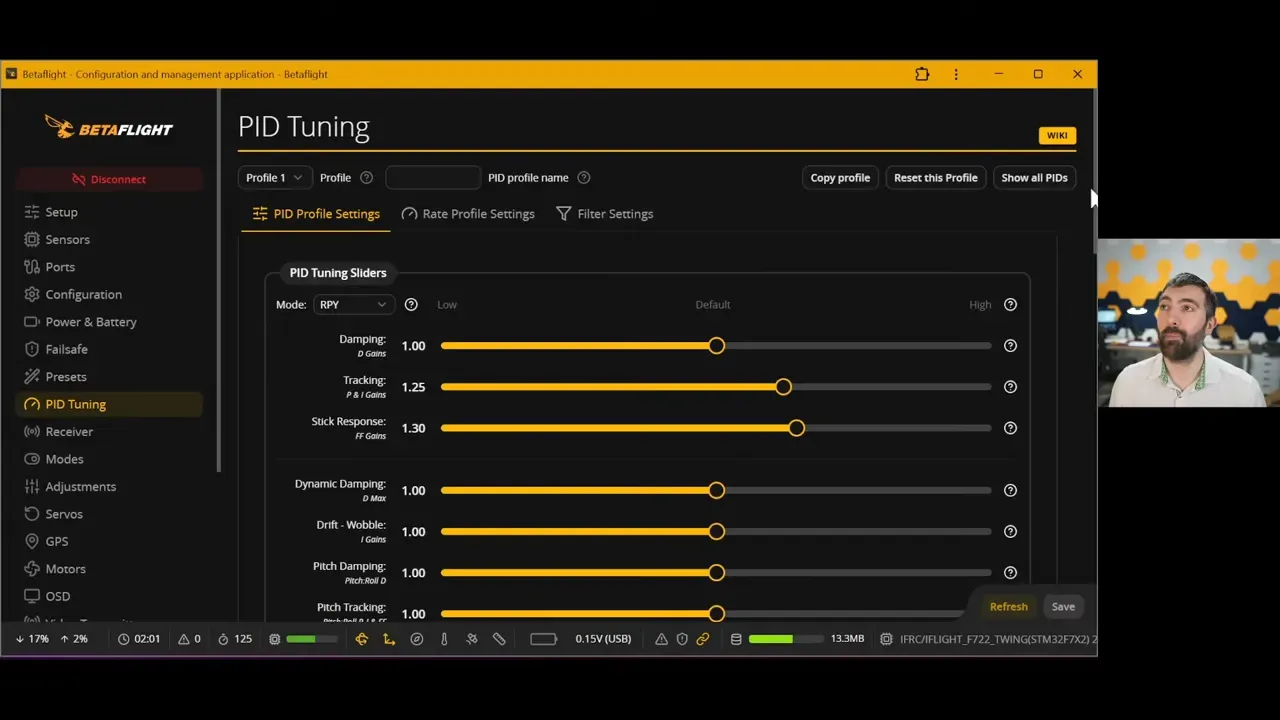
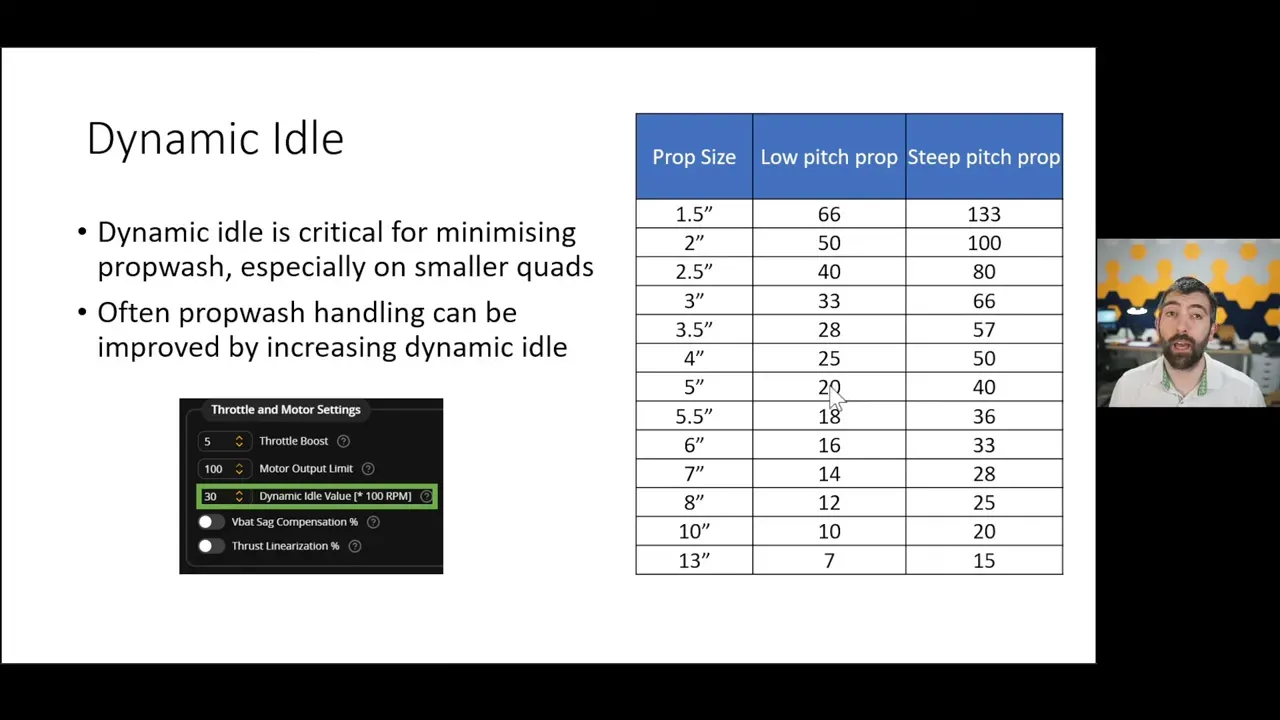
In Betaflight, Dynamic Idle lives in the PID tuning area under throttle and motor settings. The value is scaled by 100, so a setting of 30 corresponds to 3000 RPM. Chris Rosser suggests that on a typical 5 inch quad, useful values are often in the 20 to 40 range, meaning 2000 to 4000 RPM.
Smaller quads generally need proportionally higher Dynamic Idle settings to stay resilient to prop wash. Larger props usually want lower values. Flying style also matters. Very steep dives and sharp pylon turns increase the chance of severe reverse flow, which can justify a higher minimum RPM.
The trade-off is feel at zero throttle. Raise Dynamic Idle too far and the quad gets floatier. Lower pitch props make that compromise easier, because they generate less thrust at a given minimum RPM.
What Dynamic Idle values were suggested?
The suggested values depend on prop size and pitch, not on a magic internet number passed around until it becomes doctrine. The material gives a practical range and a table, rather than pretending one value fits everything.
The main pattern is straightforward:
- 5 inch quads often work around 20 to 40.
- Smaller quads usually need higher values.
- Larger props usually tolerate lower values.
- Low pitch props often work with lower Dynamic Idle than high pitch props.
If the quad still shows prop wash after throttle reapplication, increasing Dynamic Idle can help. If the quad feels too floaty at zero throttle, the setting is probably too high for that setup. There is, as ever, a compromise. Aviation remains a long series of trade-offs wearing different hats.
Is prop wash really fixable?
Yes, up to a point, prop wash is manageable with the right prop choice and RPM strategy. The video’s conclusion is not that prop wash can be abolished by optimism, but that its severity can be reduced in a predictable way.
The practical recommendation is simple:
- Choose a shallower pitch prop if prop wash handling matters.
- Use Dynamic Idle to keep RPM above the unstable transition region.
- Expect smaller quads and harsher manoeuvres to need more aggressive settings.
That combination reduces the aerodynamic step change the flight controller has to handle. Less surprise means less oscillation. The laws of fluid dynamics remain rude, but at least they become consistent.
FAQ
Can high pitch props ever be worth it if prop wash gets worse?
Yes, if the pilot values stronger thrust response or other handling traits more than prop wash performance. The trade-off is that higher pitch props tend to have a larger thrust jump during recovery from reverse flow. That makes them harder for the flight controller to manage cleanly.
Does Dynamic Idle remove prop wash completely?
No, it reduces one of the main triggers by keeping the prop out of the worst transition region. Severe reverse flow can still disturb the blade. The goal is less oscillation, not a total repeal of aerodynamics.
Why do smaller quads often need higher Dynamic Idle?
Because smaller props generally need proportionally higher minimum RPM to stay clear of the unstable recovery zone. The video states that as quad size decreases, the Dynamic Idle value needed for resilience tends to increase. Not stated in the video is a universal formula that covers every setup.
Why does the prop tip recover before the root?
The tip is moving faster, so attached flow returns there first. That attached region creates lower pressure, which drags low-energy air outward and helps reattach flow further inboard. It is a neat bit of blade-span behaviour that generic prop wash explanations usually skip.
Is prop wash just the quad flying through its own dirty air?
Not quite. Reverse flow and disturbed air create the conditions, but the oscillation comes from the blade’s upper surface stalling and then recovering over a narrow RPM range. That recovery causes large, sudden thrust changes.
What is a good Dynamic Idle starting point for a 5 inch quad?
A typical starting range given in the video is 20 to 40, which means 2000 to 4000 RPM. The right value depends on prop pitch and how aggressively the quad is flown. If the quad feels overly floaty, the setting may be too high.
This article was based from the video The Science of Prop Wash: How to Actually Fix It!