Lower frequencies should give better range and better obstacle handling. Then the real hardware shows up and reminds everyone that physics is only half the story.
TLDR: What you actually need to know
- 3.3 GHz should beat 5.8 GHz in theory, with roughly 1.75 times the range at the same power and antenna gain.
- In this test, 3.3 GHz was underwhelming, and sometimes looked no better, or even worse, than a 5.8 GHz baseline at similar power.
- 1.3 GHz should be even better on paper, with about a 5x frequency ratio advantage over 5.8 GHz, but the test result here was messy and disappointing.
- Legal use is heavily channel-dependent, especially in the USA. Some channels on these VTX tables are usable, others are very much not.
- 1.3 GHz brings baggage, especially GPS interference and possible noise from 900 MHz control systems unless filtering is used.
- Best for: tinkerers who already understand amateur radio rules, filtering, channel planning, and the phrase “secondary user” without smiling.
- Avoid if: the plan is to buy random hardware, plug it in, and expect instant long-range magic. That fairy tale did not survive contact with reality.
Let's try some NEW frequencies for FPV!
Yes, FPV does not have to live on 5.8 GHz forever. Video can be transmitted on other bands, provided two conditions are met: the band is legal to use, and actual transmitter and receiver hardware exists for it.
That makes 3.3 GHz and 1.2 to 1.3 GHz interesting. Both sit lower than 5.8 GHz, which means they come with the promise of better propagation, more range, and better behaviour around obstacles. The catch, of course, is that radio gear rarely reads the theory chapter before misbehaving.
The test setup focused first on 3.3 GHz, then on 1.3 GHz, with a 5.8 GHz baseline for comparison. The whole point was simple: not internet folklore, but what happens when the thing gets bolted to a drone and sent into the air.
Why lower frequnecies are better
Lower frequencies generally travel better. The quick mental model is audio: bass passes through walls and carries further than treble, and RF behaves in a similar way.
That improvement is not only about direct line-of-sight range. Lower frequencies also tend to cope better with obstruction. Where 5.8 GHz is prone to awkward reflections and multipath weirdness, a lower band is more likely to pass through or bend around objects.
The caveat is important. This only applies when all else is equal. In RF, all else is rarely equal for long, which is how a neat theory ends up in a muddy field arguing with an antenna.
How much difference do lower frequncies make?
On paper, the jump from 5.8 GHz to 3.3 GHz is significant. Using the ratio of the frequencies, 3.3 GHz should deliver about 1.75 times the range of 5.8 GHz with the same transmit power and antenna gain.
That means a 1 km 5.8 GHz link could become roughly 1.75 km at 3.3 GHz. Not bad for changing bands rather than simply throwing more power at the problem.
It should also improve more in cluttered environments, because the simple ratio assumes open space. Once obstacles appear, 5.8 GHz tends to age badly.
Then again, theory has never had to buy a no-name receiver from a questionable marketplace listing. Hardware quality matters.
You're likely alone on 3.3 GHz
One real advantage of 3.3 GHz is that almost nobody is using it. At a packed event where 5.8 GHz is a communal food fight, 3.3 GHz could be refreshingly empty.
That isolation cuts both ways. Nobody else is likely to be stomping on the channel, but nobody is likely to spectate either. For long-range flying, that may not matter. For a social freestyle session, it probably does.
So yes, 3.3 GHz can buy solitude. Whether that sounds peaceful or annoying depends on the day.
3.3 GHz vTX can be larger
3.3 GHz hardware is often physically bigger, especially at higher power. The tested transmitter was a GEPRC MATEN 3.3G 3 W VTX, and it was large enough to create real packaging problems.
It barely fit on a roomy GEPRC MOZ7 long-range frame. A 10 inch build still did not have enough space between the standoffs, which is the sort of detail that tends to matter after the purchase.
There are smaller 2 W versions that come closer to typical 5.8 GHz VTX size. The 3 W unit, though, is not subtle. It expects a proper long-range platform, not a tiny racer held together by optimism and zip ties.
3.3 GHz antennas are usually larger
Lower frequency means larger wavelength, and larger wavelength usually means larger antenna. There is no clever branding campaign that gets around that.
The 3.3 GHz antenna in this setup was noticeably larger than the nearby 5.8 GHz antennas. Compact designs are possible, but they often trade size for performance, which would rather miss the point here.
On a 7 inch or 10 inch long-range build, that size may be acceptable. On a small racing quad, it becomes silly in a hurry.
Is 3.3 GHz legal?
In the USA, 3.3 GHz can be legal for amateur radio use, but only within a specific slice and with caveats. At the time of the test, 3300 to 3450 MHz was the usable portion discussed.
Part of the wider 3.3 to 3.5 GHz region had already been repurposed for cellular use. That means this is not a stable forever-home for FPV gear.
If the aim is a future-proof band, 3.3 GHz is already carrying a whiff of temporary accommodation. Not ideal when the hardware is specialised and not exactly impulse-buy cheap.
Legal 3.3 GHz channels
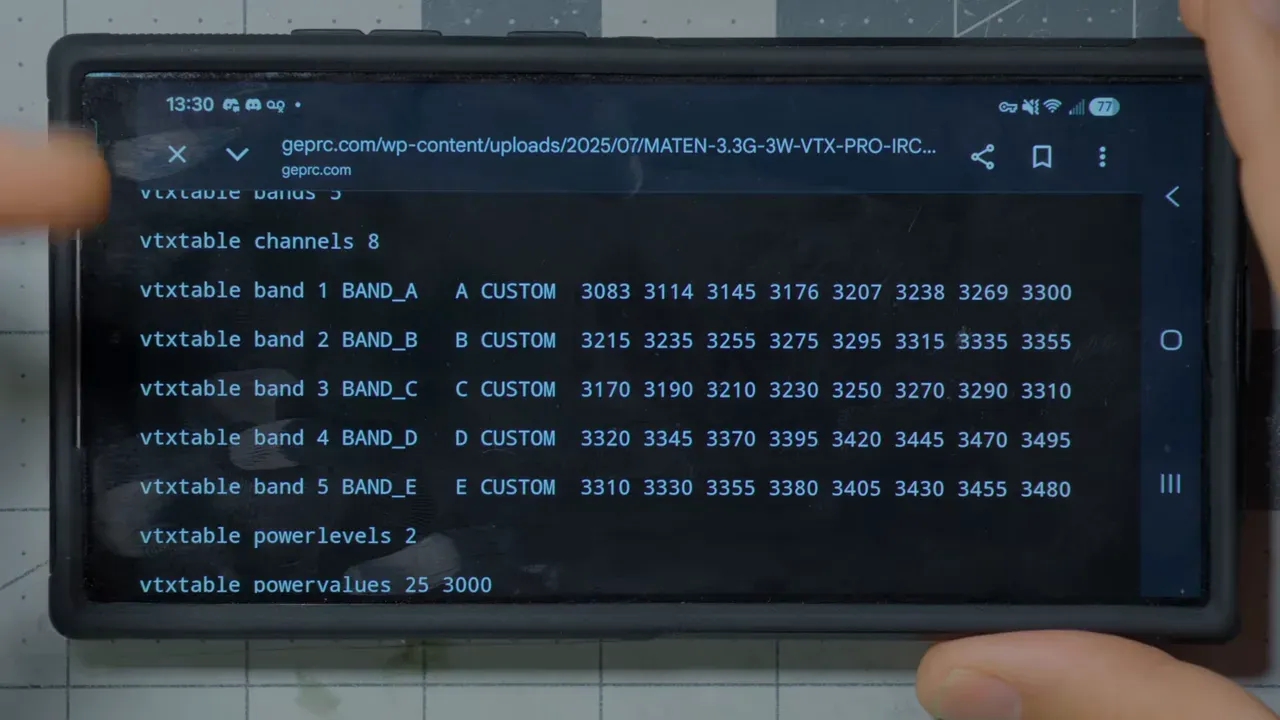
Not every channel on a 3.3 GHz VTX table is legal, and some are very much outside the line. The GEPRC table included entire bands that would be illegal in the USA.
Band A, covering 3000 to 3300 MHz, was out. Band D started to become usable from 3320 MHz upward, but its top two channels, 3470 and 3495 MHz, were too high. Band E included legal-looking channels at 3310 and 3330 MHz, while its top channels also climbed beyond the allowed range.
The practical takeaway was that Bands D and E contained usable options, provided the highest channels were avoided. This is very much a “read the table before transmitting” situation.
You are a secondary user
This matters more than many hobbyists would like. Amateur radio operators are secondary users on this band, which means they can use it only if they do not cause harmful interference to the primary users.
And those primary users are not imaginary. The band is used for radiolocation and other serious services, including military use. Near the wrong place, this is not a harmless paperwork issue.
A spectrum analyser may look clear on the ground, but that does not prove the link is harmless once the aircraft climbs and its signal travels further. That uncertainty is part of the problem.
There is also the longer-term issue that more of this spectrum may move into cellular service. If that happens, the legal use case gets even narrower, and the gear becomes a lot less useful.
Standalone vRX not goggle module
3.3 GHz reception is clunkier than 5.8 GHz because there is no common built-in goggle receiver for it. The tested GEPRC MATEN 3.3 GHz VRX was a standalone box.
That means separate mounting, separate power, and composite video output through a 3.5 mm connection into goggles or a monitor. Most analogue goggles can accept that input, but it is still one more box in the chain.
This is not impossible to live with. It is just less elegant than sliding a module into goggles and getting on with life.
Have I earned your support yet?
Joshua Bardwell’s pitch was straightforward: useful technical content exists because a fraction of the audience decides it should keep existing. The ask was Patreon support at a level lower than a set of props per month.
No miracle there. Testing oddball FPV gear, buying hardware out of pocket, and discovering that reality has jokes of its own is not free.
Baseline flight on 5.8 GHz
The baseline used 5.8 GHz at roughly comparable power, specifically a TBS Unify Pro32 running around 3 W, with actual measured output around 2.6 W depending on channel. Race 1 was chosen partly because lower 5.8 GHz channels often make slightly more power than higher ones.
An omni antenna was used instead of a patch to keep the comparison fair, since the 3.3 GHz side was also using an omni. That removed head directionality from the equation.
The route was consistent: a loop around the property, behind the house and barn, then further down the road while staying low. At 3 W, 5.8 GHz handled the initial obstacle course surprisingly well. Breakup appeared, but only in expected places.
The first genuinely uncomfortable breakup showed up farther down the road, close to the ground, after terrain started blocking the path. It was enough to cause concern for proximity flying, but not a total collapse.
3.3 GHz Test Flight
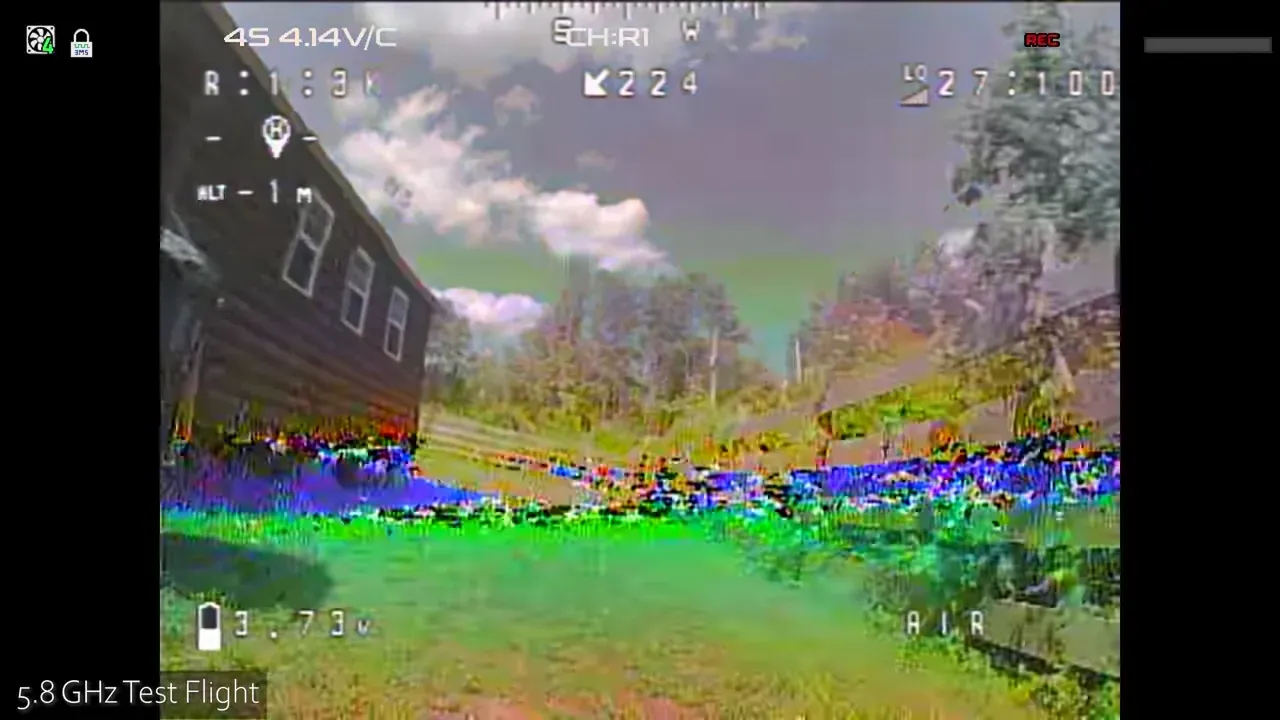
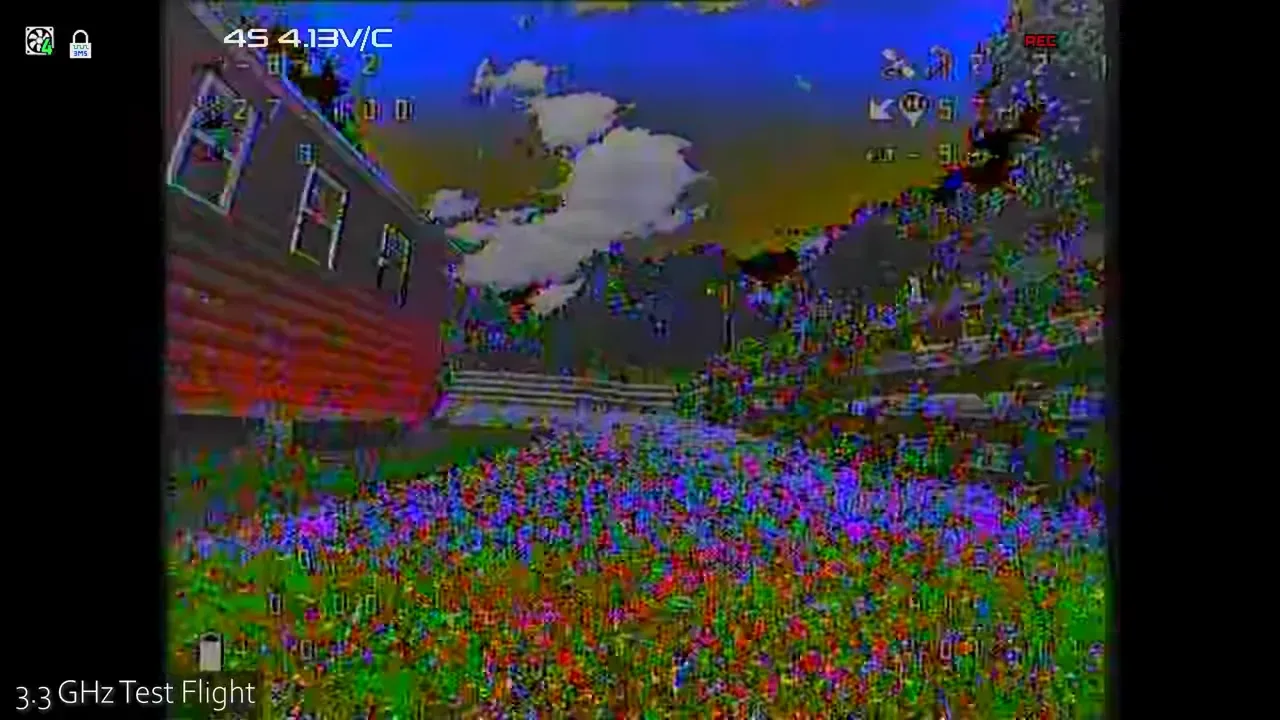
The 3.3 GHz test did not deliver the expected triumph. The antenna was positioned roughly where the 5.8 GHz antenna had been, and the receiver fed AV input on HDZero goggles.
Right away, the image showed odd colour shifting and shimmering. Some of that could have been camera-related, but the overall behaviour was not the dramatic stability boost that lower frequency theory had promised.
Behind the house and through the route, the result felt similar at best and occasionally worse than 5.8 GHz. There was less classic static in places, but enough visual weirdness and breakup to make the link feel less confidence-inspiring, not more.
Once the route opened up and altitude increased, the image still was not impressively better. The verdict from the flight was blunt: disappointing.
Why was 3.3 GHz so underwhelming
The most likely answer is hardware quality. The theory was sound, but the transmitter or, more likely, the receiver did not seem good enough to cash the cheque physics had written.
The comparison Joshua drew was to old 5.8 GHz receivers from roughly a decade ago. Early analogue VRX hardware was less sensitive, less stable, and generally rougher around the edges. Modern 5.8 GHz receivers have improved massively, to the point that people may forget how polished they have become.
3.3 GHz appears to be lagging behind that maturity curve. If the VRX is effectively ten years behind modern 5.8 GHz receiver performance, then the theoretical 1.75x advantage may simply not be enough to overcome the poorer implementation.
That is an awkward answer, but an honest one.
Is 1.3 GHz Legal
In the USA, a small part of the 1.2 to 1.3 GHz range can be legal for amateur radio use, and in some ways it is a cleaner long-term proposition than 3.3 GHz. The amateur allocation at 23 cm runs from 1240 to 1300 MHz.
The problem is width. There are only about 60 MHz to work with, and traditional analogue channel spacing wastes most of it. On the tested GEPRC MATEN 1.2 GHz 2 W VTX, there was basically one practical legal channel in the USA: 1280 MHz.
Two other channels technically sit inside the 1240 to 1300 MHz limits, but they are close enough to the edge that spillover becomes a concern, especially at higher power. So in practice, one good channel is what really exists.
In Europe, the answer given was a hard no. The band sits too close to, or on top of, services associated with Galileo, and using it for FPV video is not permitted.
1.3 GHz interferes with GPS
1.3 GHz and GPS are a famously bad pairing. On drones using a 1.2 GHz VTX, GPS units often struggle or fail outright.
The issue is common enough that getting GPS to work well alongside a 1.2 GHz video system was described as a Herculean effort. That is not exactly the sort of phrase that inspires carefree long-range confidence.
For long-range flying, GPS is usually part of the plan. If the video system undermines that, the band becomes much less attractive, unless the pilot is prepared for serious filtering, placement tricks, and compromise.
900 MHz control interferes with 1.3 GHz video
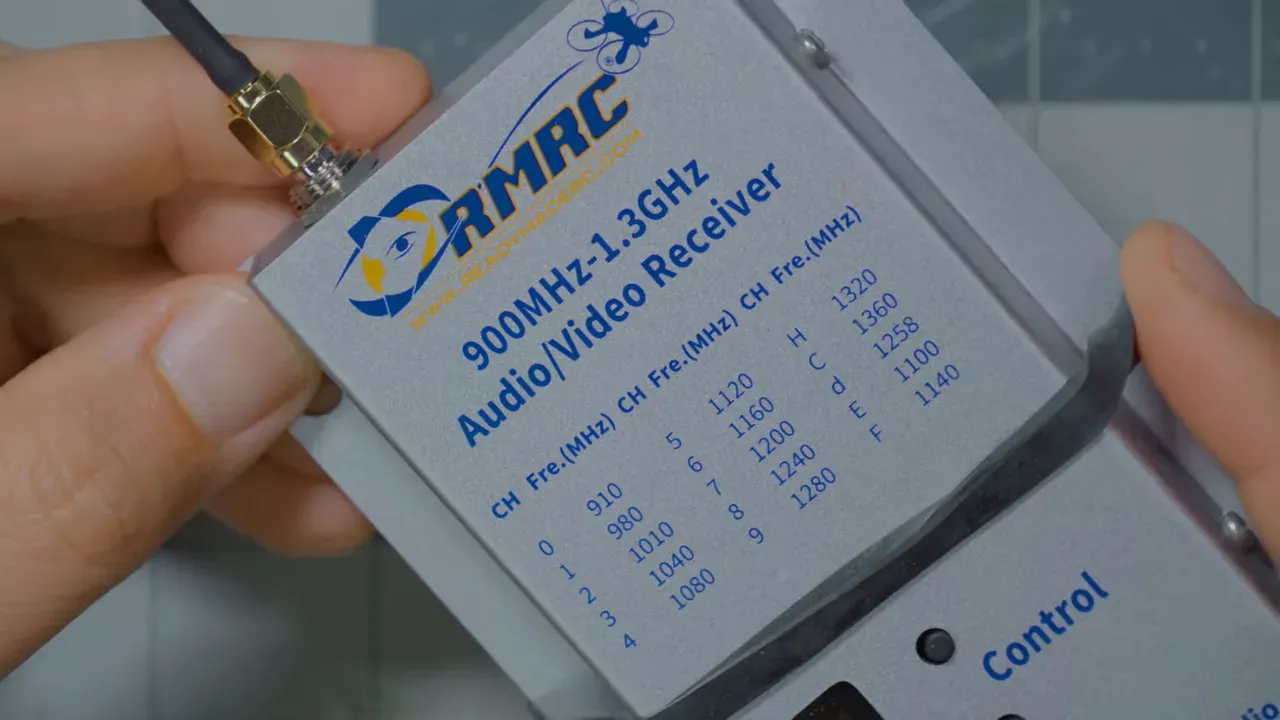
1.3 GHz video receivers can also be sensitive to 900 MHz control links, including ExpressLRS 900 and Crossfire. Yes, even though the frequencies are not right on top of each other.
The receiver discussed was a Ready Made RC unit, described as one of the better options available. It reportedly includes improved filtering for 900 MHz control interference, which is fortunate because this problem is common.
Even so, if a 900 MHz control link is in use, an external filter on the video receiver antenna path was described as basically mandatory. The symptom is visible noise in the analogue image, which at least has the courtesy to complain loudly.
1.3 GHz Test Flight
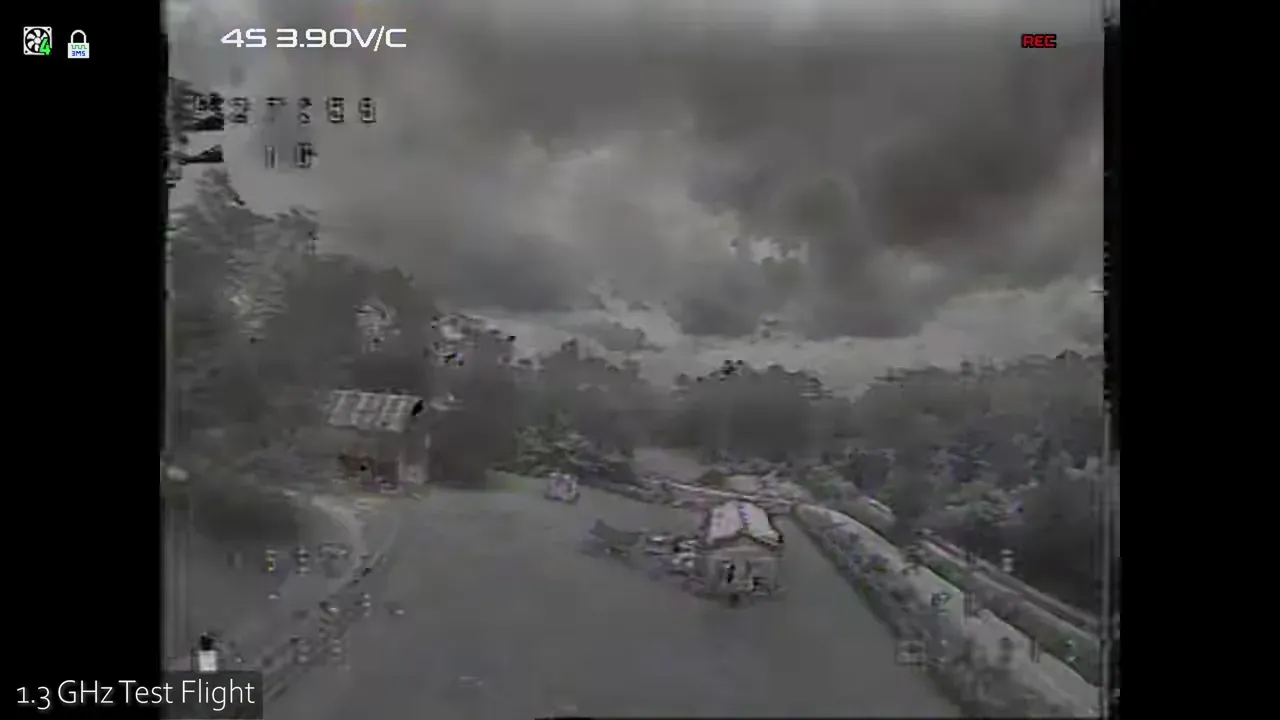
The 1.3 GHz flight was not the heroic long-range demonstration anyone hoped for. It was rough almost immediately.
Close to the ground, performance was poor. The image became horrible enough that continuing confidently was difficult. Even in areas that seemed to offer fairly clear line of sight, the link could turn ugly fast.
That was especially frustrating because 1.3 GHz has a strong reputation among long-range pilots, and the theoretical case is even stronger than 3.3 GHz. Yet this specific setup did not produce those results.
Conclusion
The conclusion was not that lower frequencies are a myth. It was that using them successfully is not as simple as buying a VTX and VRX, plugging them in, and assuming physics will do the rest.
3.3 GHz should have delivered around 1.75 times the range advantage over 5.8 GHz, and 1.3 GHz should have looked even better on paper. The actual tests did not reflect that promise. The likely reason is immature or poor hardware, plus the usual legal and interference traps.
That leaves 5.8 GHz looking better than it has any right to, largely because the ecosystem is mature, refined, and easy to use. Annoyingly sensible, really.
The practical takeaway is simple:
- If the goal is a dependable analogue FPV setup, 5.8 GHz still wins on maturity and convenience.
- If the goal is experimentation, 3.3 GHz and 1.3 GHz are interesting, but they demand channel planning, legal homework, and better hardware than this test may have had.
- If the plan was “same as before, but better”, that plan needs revision.
FAQ
Is 3.3 GHz better than 5.8 GHz for FPV?
In theory, yes. In this test, no clear real-world win appeared, and the 3.3 GHz hardware often looked unstable or underwhelming compared with 5.8 GHz.
Is 1.3 GHz legal for FPV in the USA?
A small part of it can be, for amateur radio operators, with 1240 to 1300 MHz being the relevant allocation mentioned. In practical terms, only one channel around 1280 MHz looked comfortably usable in this setup.
Why does 1.3 GHz FPV interfere with GPS?
Because the band sits very close to GPS-related frequencies. The result is that GPS modules on the drone may struggle to lock satellites or may fail badly unless the installation is carefully engineered.
Can 900 MHz ExpressLRS or Crossfire affect 1.3 GHz video?
Yes. The receiver can pick up interference from 900 MHz control transmissions, which shows up as noise in the video. A filter on the video receiver side was described as basically mandatory.
Why are 3.3 GHz antennas bigger than 5.8 GHz antennas?
Because antenna size relates to wavelength, and lower frequencies have longer wavelengths. That makes physically larger antennas normal, not a design mistake.
Can 3.3 GHz FPV be used with normal goggles?
Usually yes, if the goggles have analogue AV input. The 3.3 GHz receiver used here was a separate standalone box that fed composite video into the goggles.
This article was based from the video Best frequency for FPV: 1.3 GHz vs. 3.3 GHz vs. 5.8 GHz!