The GEPRC TriPro LR60 is a light 6-inch cinematic cruiser built around flight time, DJI O4 recording and modularity, not repeated attempts to occupy the same tree branch at 90mph. It can make a compelling case for itself, but it ships with a few setup choices that deserve immediate correction.
TLDR: What you actually need to know
- Best for: cinematic cruising, gentle mountain lines and controlled car-chase work on private land or a racetrack.
- Avoid if: the plan involves racing, hard freestyle, indoor flying or treating crashes as routine maintenance.
- The bare TriPro LR60 weighs 343g, including its DJI O4 Pro hardware and protective camera cage.
- The 3,000mAh 6S Li-ion pack delivered roughly 25 minutes of total flying and test time, with restrained throttle use.
- A 2,200mAh 6S LiPo produced more authority and about 140kph, versus roughly 100 to 103kph on the partly depleted Li-ion pack.
- It ships with Betaflight 4.5.3, which leaves useful GPS features and easier battery-profile switching on the table.
- Before flying, disable FPV Camera Mix and DShot motor beacon, verify battery voltage thresholds, and remove the battery mounting plate if it lets the pack move.
What even IS this drone?
The GEPRC TriPro LR60 is a compact, lightweight 6-inch cinematic quad, sitting somewhere between a traditional long-range machine and a conventional 5-inch FPV quad.
It is not a freestyle drone. It is not a racing drone. It is also not a ducted cinewhoop, and it lacks the big-frame, giant-battery character normally associated with long-range builds.
The recipe is unusual but coherent: 2205 1400KV motors, two-blade 6-inch props, a centrally concentrated frame and a claimed focus on efficiency. Those 2205 motors are small for a 6-inch prop, even small by many 5-inch standards. The only reason that arrangement makes sense is the all-up weight.
At 343g dry, the TriPro LR60 is only modestly heavier than a 291g lightweight 5-inch racing build used for comparison. That figure includes the DJI O4 Pro system and the metal camera cage, which makes the weight saving more than a marketing séance.
The practical result is a machine that can cruise for a long time, cover scenery smoothly and still carry enough speed for exterior moving shots. It cannot be bullied into crisp racing turns or aggressive freestyle transitions without showing its limits.
Takeaway: buy this as a dedicated cinematic platform. A 5-inch freestyle quad can record cinematic footage, but it will not gain the TriPro's endurance merely by being asked nicely.
Swappable vtx and camera module
The modular DJI O4 Pro camera and VTX cage is one of the TriPro LR60's strongest ideas.
The air unit and camera sit inside a metal cage that can be removed with a couple of screws. GEPRC uses the same general module concept across its cinematic products, making it possible to move a costly DJI O4 unit between compatible models rather than buying several of them. DJI O4 hardware is not cheap enough to regard as consumable, sadly.
The camera and air unit are soft-mounted on rubber bobbins. That isolation should reduce vibration reaching the recorded footage. The cage also provides access to the O4's SD-card slot and bind button.
GEPRC added a USB extension, so the otherwise awkward O4 USB port remains accessible. That is the sort of detail that suggests someone has attempted to plug a cable into an air unit after it has been installed.
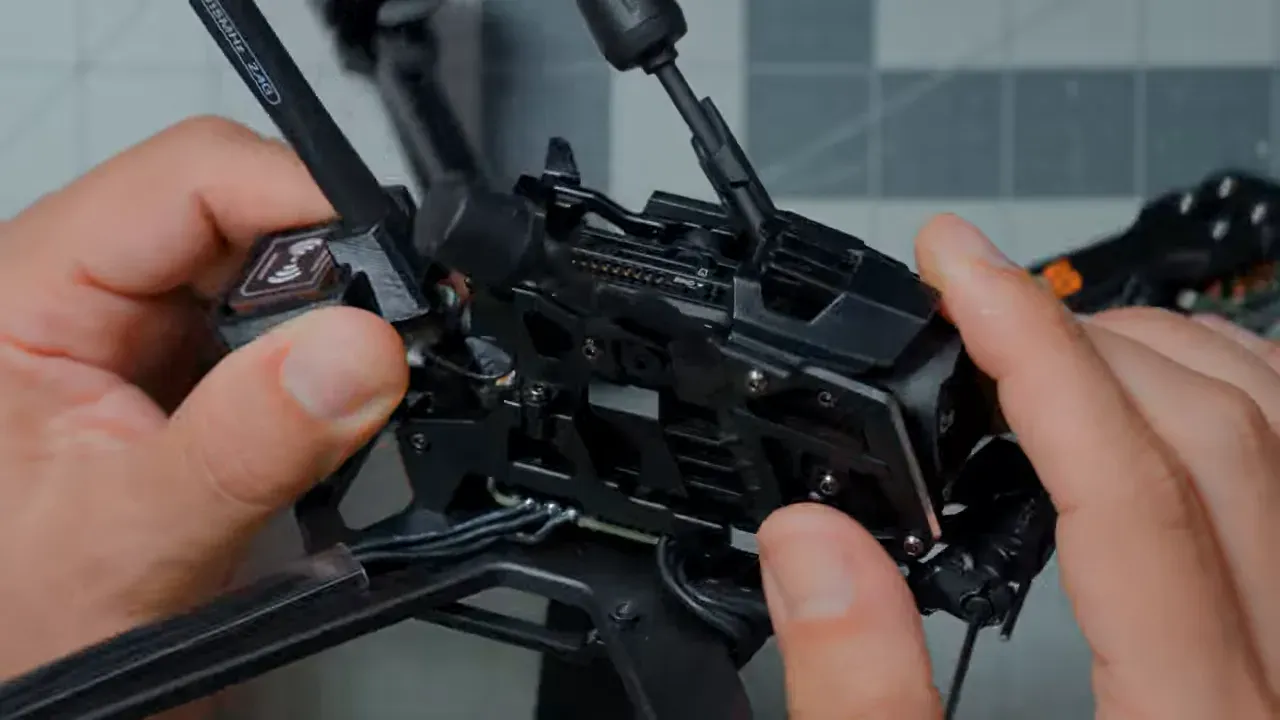
There is one weak point. The upright antenna mounts have broken easily in previous testing of GEPRC cinewhoops using this system. They are replaceable and spare parts are included, but a flexible TPU replacement would inspire more confidence after even a minor mishap.
Takeaway: the modular O4 cage is genuinely useful for a pilot building a compatible GEPRC cinematic fleet, but inspect the antenna mounts after any contact with the ground.
Dual-band ELRS receiver with new type of antenna
The TriPro LR60 includes a GEPRC dual-band 900MHz and 2.4GHz ExpressLRS receiver with a dual-band 915MHz and 2.4GHz antenna.
The receiver supports ELRS Gemini operation. That can mean simultaneous transmissions across two bands, or two signals on one band for improved link resilience. A second antenna mounted toward the front also gives physical antenna diversity if the rear antenna becomes shielded by the airframe or battery during flight.
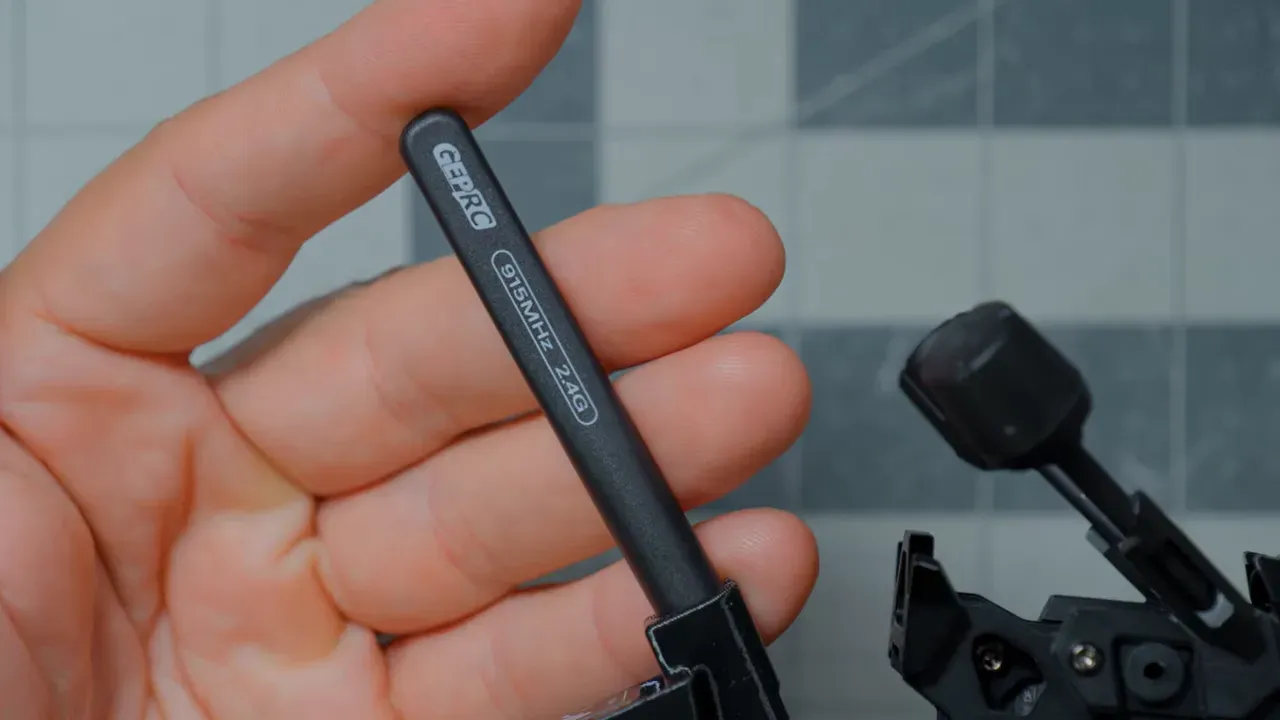
This antenna form factor is unusual. Dual-band wire antennas are familiar territory, but fitting that capability into this compact upright assembly is less common.
Takeaway: the control-link hardware is unusually well specified for a cinematic 6-inch quad, though its firmware setup has a catch later on.
It comes with a GPS ... but?
The TriPro LR60 has a GPS, but its recorded GPS performance was merely adequate rather than confidence-inspiring.
GPS is valuable on a cruiser because a failsafe over a distant hillside is not normally followed by a relaxed walk to retrieve the quad. It also enables Betaflight GPS Rescue, return-to-home functions and, with newer firmware, position and altitude hold.
During the Li-ion flight, the receiver generally held six to eight satellites, occasionally climbing to nine or 10. Better-installed GPS systems commonly show about 14 to 18 satellites in comparable use.
The HDOP or PDOP value sat around 3.8m. Lower values indicate better positional accuracy, and a value below 2.0 is preferable for more accurate rescue behaviour.
GPS Rescue did climb, turn toward home and reduce the distance to home. It worked in the basic sense. Its return path visibly bobbled, though, and does not justify treating it as an autopilot with a mortgage.
Joshua Bardwell's single hardware change would be shielding the GPS wiring with foil to reduce interference. The GPS sits close to an antenna, although it is separated from the video antenna.
Takeaway: GPS Rescue is better than an uncontrolled failsafe, but wait for a solid satellite lock and do not expect elegant return behaviour from the supplied setup.
FC and ESC
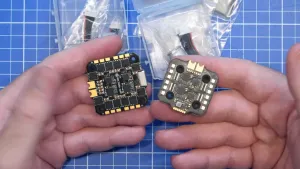
The flight controller is a GEPRC TAKER F722 all-in-one unit with an integrated 45A ESC.
Forty-five amps may seem modest on a 6-inch quad. Here, it suits the design. The TriPro LR60 is not intended for sustained full-throttle pulls, high-KV motors or repeated freestyle recovery moves.
The 45A figure is a continuous rating. Short current peaks may exceed it, but the 2205 1400KV motor and two-blade prop combination should remain within reasonable territory when flown for efficiency.
Takeaway: the electronics fit the cruiser brief. They are not evidence that this is secretly a 6-inch race quad wearing a sensible shirt.
Why pusher motors and how to install props
The pusher motor layout slightly offsets the front and rear propeller planes, aiming to give the rear props cleaner air in forward flight.
Front propellers disturb the air before it reaches the rear motors. Moving the front motors to the lower plane separates the prop discs slightly, which may reduce turbulence at the rear. The expected benefit is smoother flight and slightly lower rear-motor workload.
The effect is likely modest. Larger offsets between front and rear motors would make a more obvious aerodynamic case. Still, the layout does no obvious harm, and the bottom-mounted battery means the quad lands on the battery rather than the props.
Prop installation is where a pusher layout can ambush the unwary. The TriPro LR60 is configured for props-in. The rear props install normally. For the front pusher motors, do not simply flip the frame over and copy the usual top-view prop orientation.
- Identify the top surface of each propeller.
- Fit the prop so its thrust direction matches the normal props-in layout when the quad is viewed from above.
- On a pusher motor, this means the prop is physically upside down relative to the motor, but correctly oriented relative to the thrust plane.
- Check the finished quad from above. All four propellers should still read as props-in.
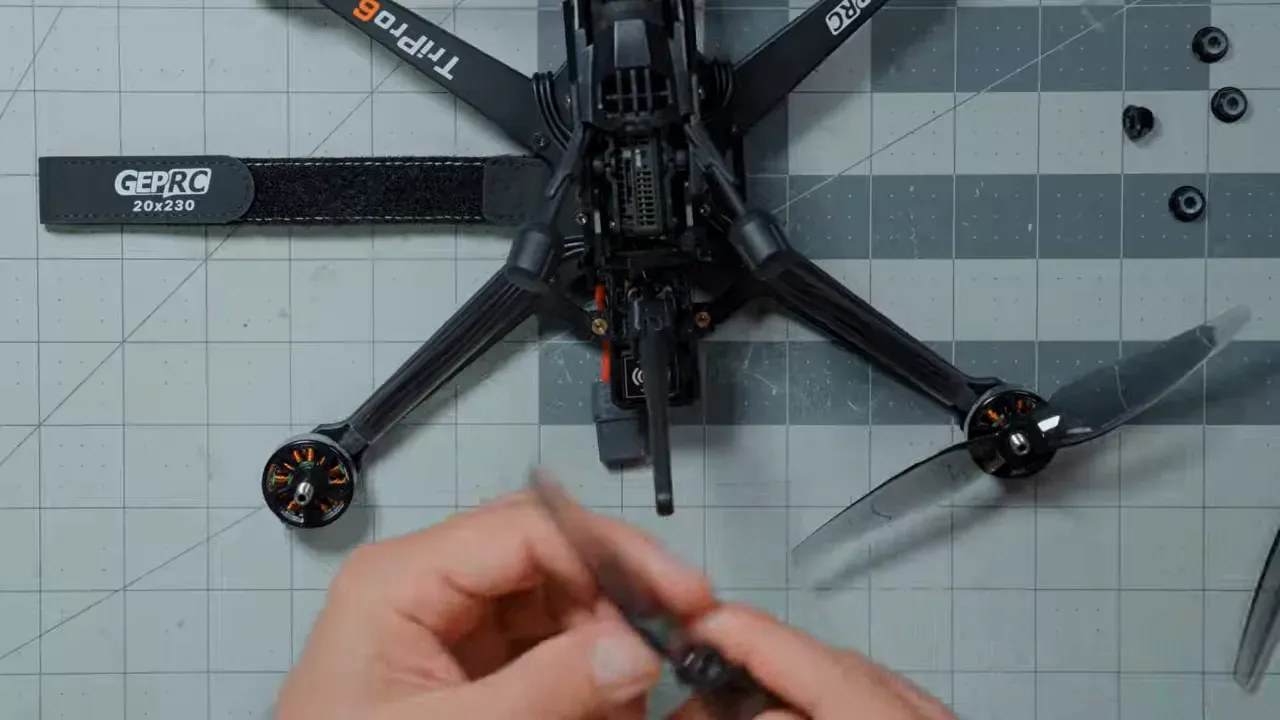
Takeaway: install front pusher props according to thrust direction, not according to which side of the motor happens to be facing the ceiling.
Recommended batteries
The battery choice determines whether the TriPro LR60 becomes a long-duration camera platform or a noticeably more energetic cruiser.
GEPRC recommends a 2,200mAh 6S1P LiPo and a 3,000mAh 15C Li-ion pack. The 2,200mAh LiPo weighed 350g, producing a 720g all-up weight. The 3,000mAh Li-ion weighed 300g, producing a 666g all-up weight.
The Li-ion setup provided the endurance result. Roughly 15 to 16 minutes of visible flight plus six to seven minutes of test flying gave a total near 25 minutes. It had modest punch and clear voltage sag under load, but held up acceptably in a late-flight full-throttle test.
Li-ion speed reached around 100 to 103kph near the end of the pack. That is adequate for broad cinematic movement, but a poor choice for demanding car chases or heavy wind.
The LiPo changed the character of the quad. It hit roughly 140kph at full throttle, and 80kph arrived at only 47% throttle on a fresh pack. It still was not a sharp-turning freestyle machine, but it was much more enjoyable and responsive.
The LiPo flight reached 3.60 to 3.67V per cell after about seven minutes, which was treated as a sensible point to return. More power, less endurance. Physics remains stubbornly conventional.
Takeaway: choose Li-ion for long, gentle landscape work. Choose the 2,200mAh LiPo for speed, wind margin and moving exterior shots.
Very disappointed to see BF 4.5.3
Shipping the TriPro LR60 with Betaflight 4.5.3 is the most frustrating part of the factory setup.
Betaflight 4.5.3 is not broken. It is simply old enough to omit capabilities that make particular sense on a GPS-equipped cinematic cruiser.
Betaflight 2025.12 added position hold, altitude hold and an improved return-to-home function. Betaflight 4.5.3 has GPS Rescue, but not position hold or altitude hold. The newer 2026.6 release also introduced battery profiles, which matters when swapping between LiPo and Li-ion packs.
A firmware update is not difficult for an experienced builder, but a ready-to-fly cinematic quad should not require one just to access its sensible GPS and battery-management features.
Takeaway: update to at least Betaflight 2025.12 after backing up the factory configuration. Consider 2026.6 only after assessing its stability for the intended use.
Recommend disabling FPV Camera Mix
FPV Camera Mix should be disabled on the supplied configuration.
Camera Mix combines roll input with yaw input to create flatter turns at a defined camera angle. If the craft flies at the configured 15-degree camera angle, yaw can feel more like a coordinated turn.
It works poorly at other pitch angles. The TriPro LR60 ships with its camera locked at 0 degrees, yet its Betaflight configuration uses 15 degrees for this feature. That creates yaw and roll behaviour which can feel as if the quad has camera downtilt. A useful flight aid has become an unnecessary control-law practical joke.
Set the value to zero or disable FPV Camera Mix. Add physical camera uptilt if wanted, then fly the quad normally.
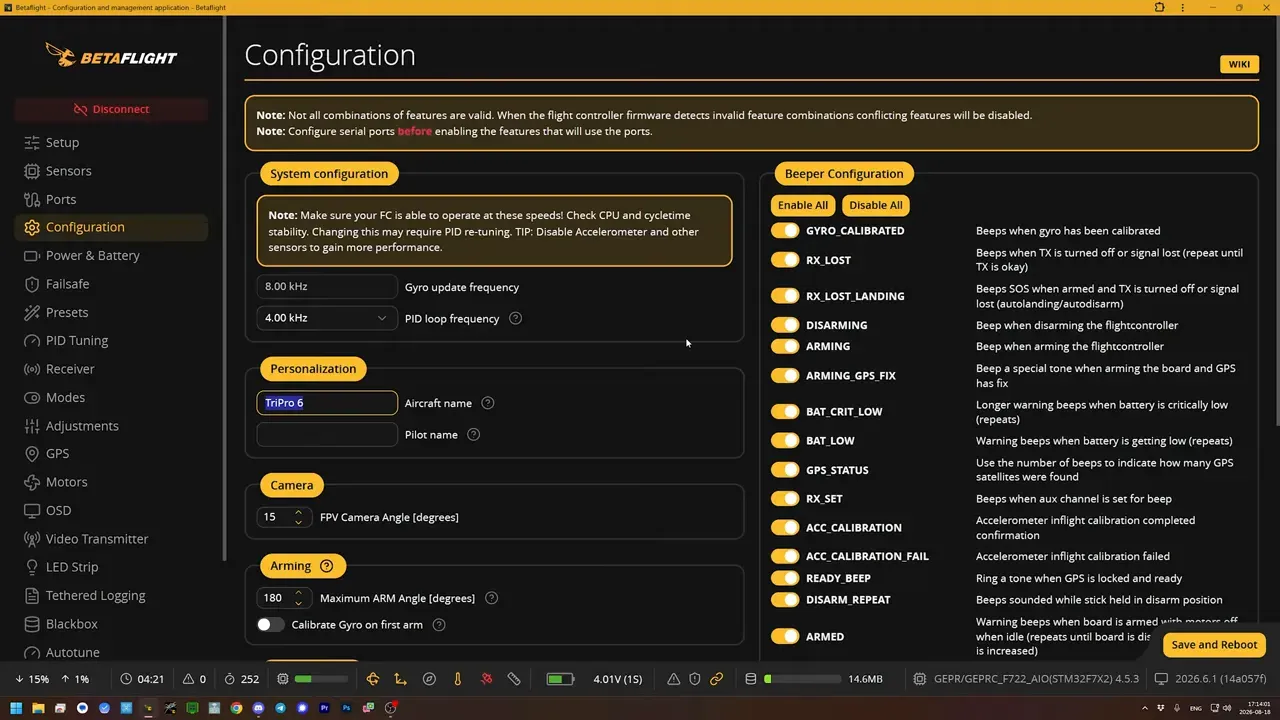
Takeaway: do not leave a 15-degree Camera Mix setting enabled with a physically zero-degree camera.
Good: Small Angle Disabled
The maximum arm angle is set to 180 degrees, which is the right factory choice.
This allows the TriPro LR60 to arm when it is not perfectly flat and level. That is useful when launching from uneven ground, a slope or a less-than-pristine field setup.
Takeaway: leave this setting alone unless there is a specific operational reason to restrict arming angle.
Recommend disable motor buzzer
Disable the DShot motor beacon because the TriPro LR60 already has a real buzzer.
The quad includes an actual beeper, yet DShot beacon is also enabled. Motor beeps are quieter than a dedicated buzzer and can prevent arming while the ESC is busy performing its concert for reluctant appliances.
In Betaflight, disable the DShot beacon options in the beeper configuration. Retain the physical buzzer for recovery and warning functions.
Takeaway: one locator beeper is enough. Keep the louder, more useful one.
Battery thresholds need to be adjusted for LiPo vs. LiOn
Battery voltage thresholds must change when swapping between LiPo and Li-ion packs, and the factory firmware makes that inconvenient.
LiPo cells should not be treated like cylindrical Li-ion cells. The discussion uses about 3.0V as a LiPo lower threshold, while Li-ion can be used down to 2.5V absolute minimum. In normal use, the Li-ion pack became significantly saggy around 2.7 to 2.8V per cell, so returning around 2.8 to 2.9V leaves useful margin.
With factory thresholds left unchanged, the Li-ion test flight triggered a low-battery warning around 3.3V per cell. That warning was premature for the battery chemistry, not evidence that the pack had suddenly developed a philosophical objection to flight.
Betaflight 2026.6 battery profiles would allow separate LiPo and Li-ion settings, switched easily in the field. On the supplied version, the values need manual adjustment in Betaflight Configurator whenever chemistry changes.
Takeaway: check warning and minimum cell voltage before every battery-type swap. Incorrect thresholds mean nuisance warnings at best, or damaged cells at worst.
ELRS receiver oddness
The installed ELRS receiver ships on ExpressLRS 3.x and does not enter Wi-Fi mode through the usual automatic timeout method.
That firmware version is understandable, since ELRS 4.x was still relatively new. The complication appears during updating. Waiting the normal 60 seconds did not put the receiver into Wi-Fi mode, even after several minutes.
There are two practical routes to update it:
- Flash the radio back to ELRS 3.x, bind the receiver, use the Lua script to start Wi-Fi mode, then update the receiver to ELRS 4.x.
- Use the physical button on the receiver. Hold it to enter bind mode, then continue holding it to enter Wi-Fi mode.
The button sits close to an antenna cable, so proceed with care. ELRS Mobile was used successfully for receiver flashing and avoids needing a PC for much of the process.
Takeaway: do not wait indefinitely for automatic receiver Wi-Fi mode. Use the small physical button, carefully, if the timeout method fails.
Is the GEPRC TriPro LR60 worth buying for cinematic FPV?
The GEPRC TriPro LR60 is worth considering for pilots who want a light, DJI O4-equipped 6-inch quad dedicated to cinematic exterior flying.
Its best work is calm and deliberate: long scenic passes, top-down mountain lines, broad cruising and controlled vehicle work where enough speed matters but racing response does not. It has substantially more flight time than a typical 5-inch freestyle quad configured for similar footage.
It should not be used for indoor work. It is too large and not designed for that role. It also should not be selected for racing, hard freestyle or casual crash resistance.
The Li-ion result supports the core concept. Roughly 25 minutes from a 3000mAh 6S pack is useful endurance for a compact 6-inch platform. The LiPo option provides enough speed and power for more assertive outdoor tracking shots.
There are caveats. GPS performance was weak, rescue behaviour was functional but unattractive, the battery plate allowed movement, and the factory Betaflight version is behind the useful feature set. The soft-mounted O4 system produced good Gyroflow-stabilised footage in this test, without signs of the DJI O4 gyro bug, but that one unit cannot prove every O4 will behave.
GEPRC reportedly identified some early footage wobble and advised fitting an included ND filter plus roughly 10g of counterweight above the O4 unit. A proper counterweight was expected to be fitted on later units. In testing, two bolts served as the 10g counterweight because engineering sometimes begins with a bolt and a bad idea.
A separate shake during LiPo flying had a simpler cause. The supplied battery mounting plate prevented the strap from gripping the pack properly. Removing the plate allowed the rubber-lined strap and grippy frame pad to hold the battery firmly, resolving the instability.
Takeaway: this is good at what it intends to be. Perform the firmware and configuration housekeeping, secure the battery properly, and fly it as a cinematic cruiser rather than asking it to become something louder and more expensive.
FAQ
How long does the GEPRC TriPro LR60 fly on a 3000mAh Li-ion battery?
The Li-ion test produced roughly 25 minutes of combined flying and test time. That estimate included around 15 to 16 minutes of the main flight plus earlier testing. Gentle cruising gave the best result.
Can the GEPRC TriPro LR60 do freestyle?
It can perform some aggressive moves, but it is not designed for freestyle. The small 2205 motors and 6-inch props become less stable during abrupt throttle and turning inputs. It is also not intended to crash repeatedly.
Why is the TriPro LR60 shaking during throttle changes?
Check battery movement first. A loose LiPo caused visible shaking during the test because the supplied mounting plate stopped the strap gripping the pack properly. Removing that plate allowed the grippy strap and battery pad to secure the pack.
Should FPV Camera Mix be enabled on the TriPro LR60?
No, not with the supplied 0-degree locked camera angle and 15-degree Camera Mix setting. That mismatch can make yaw and roll response feel wrong. Disable the feature or set its configured angle to zero.
Does GPS Rescue work on the GEPRC TriPro LR60?
It worked at a basic level in testing. The quad climbed, turned toward home and reduced its distance from the home point. Satellite count and positional accuracy were not impressive, so it should remain a failsafe tool rather than a flight mode to admire.
Why does the TriPro LR60 give a low-battery warning with Li-ion?
The factory Betaflight voltage thresholds suit LiPo use more closely than Li-ion. Li-ion cells tolerate lower voltage, but they also sag under throttle. Adjust warning and minimum cell voltage values whenever switching chemistry.
Why will the ELRS receiver not enter Wi-Fi mode automatically?
The tested receiver did not enter Wi-Fi mode after the normal timeout. Hold the receiver's small button to enter bind mode, then Wi-Fi mode, before flashing. Take care around the adjacent antenna cable.