Your next improvement in FPV probably does not need a new flight controller. Nick Burns makes the case for RaceGow 6: a free global event that turns a small home-built track—or a simulator—into a reason to get more useful stick time.
TLDR: What you actually need to know
- Entry cost: RaceGow participation is free; physical track materials still cost money. Burns paid about $7 for 12 feet of PVC.
- Demonstrated result: Two practice runs on the same indoor track returned reported times of 34.21 and 31.30 seconds, not official submitted results.
- Setup limitation: Real-world entries need recording; Burns understands that a mobile phone can qualify, but the event rules decide.
- Best for: Whoop pilots, freestyle pilots and casual cruisers who want repeatable precision practice rather than aimless battery consumption.
- Avoid if: You expect free entry to mean free hardware, or intend to build a competition track without checking its dimensions.
What is RaceGow 6, and why bother if you do not race?
RaceGow is a global event built around tracks you recreate locally, fly and submit results for. Season six also includes simulator participation, so owning a suitable quad or clearing a room is not the only route in.
The useful bit is the structure. A defined course gives your practice a target, a time and a reason to repeat it; the racing label does not oblige you to become a full-time leaderboard obsessive.
- At home: Build a compact track in a cleared room, basement or garage.
- Outside: Scale the layout up for a larger quad, following the event’s requirements.
- On a computer: Use the official simulator tracks rather than building physical gates.
- With other pilots: A shared practice session gives you both laps and people to compare notes with.
Burns contrasts this with his usual house-wide Whoop flying. A compact course is a different exercise: less roaming through rooms, more controlled movement through closely spaced obstacles. His argument is that this precision carries over to outdoor gap shooting and larger aircraft.
Bench Note: This is a practice framework, not a firmware upgrade for your thumbs. The gates provide the problem; repeated flying still has to provide the answer.
That applies across flying styles. Racing can sharpen freestyle control, freestyle can broaden racing skills, and a casual cruiser can simply become more comfortable in the goggles. The intended result is less conscious wrestling with the sticks and more natural coordination between what you see and what your fingers do.
Do you need a Tiny Whoop, prop guards or a particular video system?
Not exclusively. Burns describes season six as accepting a broader range of aircraft, including quads with add-on prop protection, unguarded quads and larger builds on appropriately scaled tracks.
| Equipment choice | What Burns describes | Practical limitation |
|---|---|---|
| Traditional Whoop | Suitable for compact indoor practice | You still need room for the prescribed track |
| Add-on guards or no guards | Not restricted to traditional Whoop ducts | Check the applicable class and rules |
| 5-inch quad | Larger aircraft can use a scaled-up layout | Track scale and available space must match |
| DJI or HDZero video | HD flying is supported in Burns’s description | A video system does not replace submission requirements |
| Simulator | Official virtual tracks offer another entry route | Follow the simulator-specific process |
His second demonstration uses the aircraft he calls the P1, on the same track in the same room. The point is equipment flexibility—not a controlled comparison proving one video system or airframe faster than another.
Warning: “You can fly a 5-inch” is not a sensible instruction to launch one beside the kitchen table. Event eligibility and a suitable flying space are different questions.
There is no need to invent a receiver protocol, motor specification or flight-controller requirement here. Burns’s pitch concerns practice and participation, not a mandated electronics stack.
How do you build a RaceGow track without buying expensive gates?
PVC pipe and push-fit connectors are Burns’s straightforward option. Assemble the required layout, fly it, then pull it apart when the room needs to become a room again.
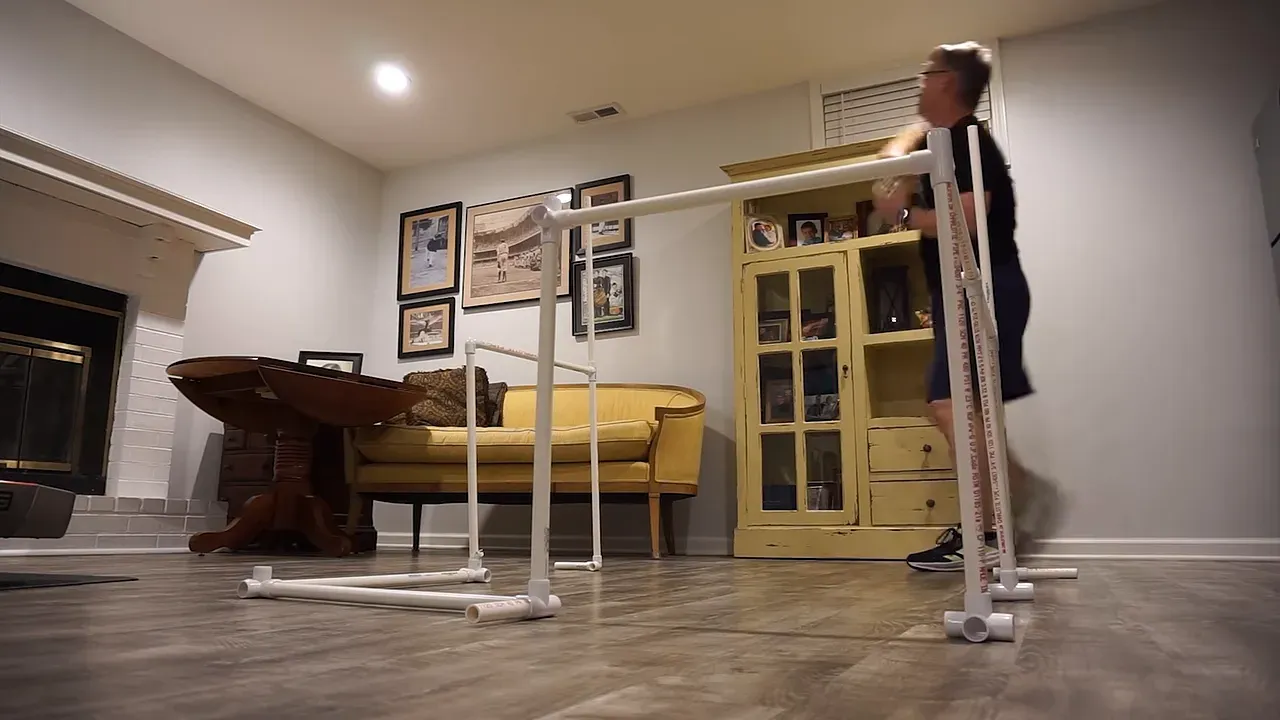
Caption: The physical course uses freestanding PVC frames in an ordinary furnished room.
Burns had to dismantle his course quickly before hosting his teenager’s homecoming gathering. That is a useful design requirement: a practice track that can pack away is more likely to survive domestic negotiations.
| Material | Reported cost or option | Build consideration |
|---|---|---|
| PVC pipe | About $7 for 12 feet | Local prices vary; this is not a complete-track price |
| Connectors | About $2–$4 each, depending on type | Multi-way fittings can cost more than expected |
| Existing racing gates | Can be incorporated | The required layout still matters |
| Broomsticks or fallen branches | Suggested alternatives with twine and duct tape | Material choice does not excuse incorrect geometry |
PVC is the cleanest and easiest approach in Burns’s assessment, but it is not sacred. Existing gates or improvised materials can serve the same purpose if they reproduce the required course.
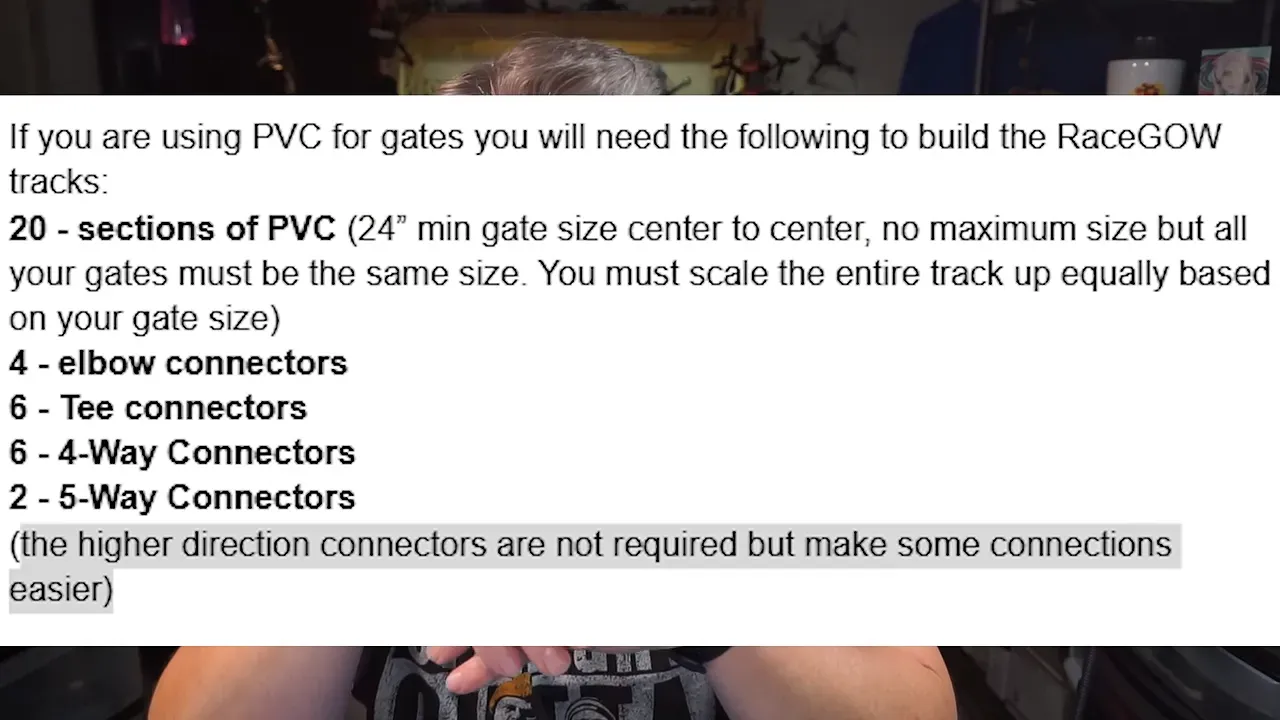
Caption: The materials list is a better starting point than buying a random armful of plumbing fittings.
- The Catch: Free entry does not cover pipe and fittings.
- The Cost Trap: Several $2–$4 connectors can matter more to the bill than the cheap pipe.
- The Workaround: Check the official materials list first, then reuse suitable gates or materials you already own.
Burns considers this cheaper than buying traditional gates, with the benefit that the parts remain available for future layouts. Do not read his $7 pipe purchase as a promise that an entire season’s track kit costs $7. Plumbing arithmetic remains arithmetic.
How do you record and time a RaceGow submission?
Real-world participation needs a recording. Burns understands that a mobile phone recording can be accepted without a dedicated DVR, but explicitly defers to the official rules.
- Recording: Establish an accepted recording method before spending a session chasing a submission time.
- Timing: Burns names Tiny FPV Lap Timer as one option for practice.
- No lap timer: His demonstrations use an added timecode to measure the runs.
- Other timers: He had been trying two alternatives, but was not ready to recommend or demonstrate them.
The distinction matters: a tool that tells you a practice time is not automatically an approved competition submission method. Burns’s timecoded examples were demonstrations, not confirmed official entries.
The Catch: A fast run with the wrong evidence is still the wrong evidence. Read the recording and submission requirements before treating your phone, DVR or timecode overlay as sufficient.
For simulator participation, Burns understands that results on official tracks are recorded automatically rather than requiring the same manual submission process. Treat that as something to verify for your chosen simulator, not a universal promise about every FPV sim.
If connecting the radio is the obstacle, our guide to FPV simulator radio connectivity covers connection methods. It solves the controller problem; RaceGow’s own instructions still govern the event process.
What do the 34.21- and 31.30-second runs actually prove?
They demonstrate that Burns can practise a repeatable course in a compact indoor space and attach a measurable time to it. They do not establish a benchmark for airframes, video latency or pilot improvement.
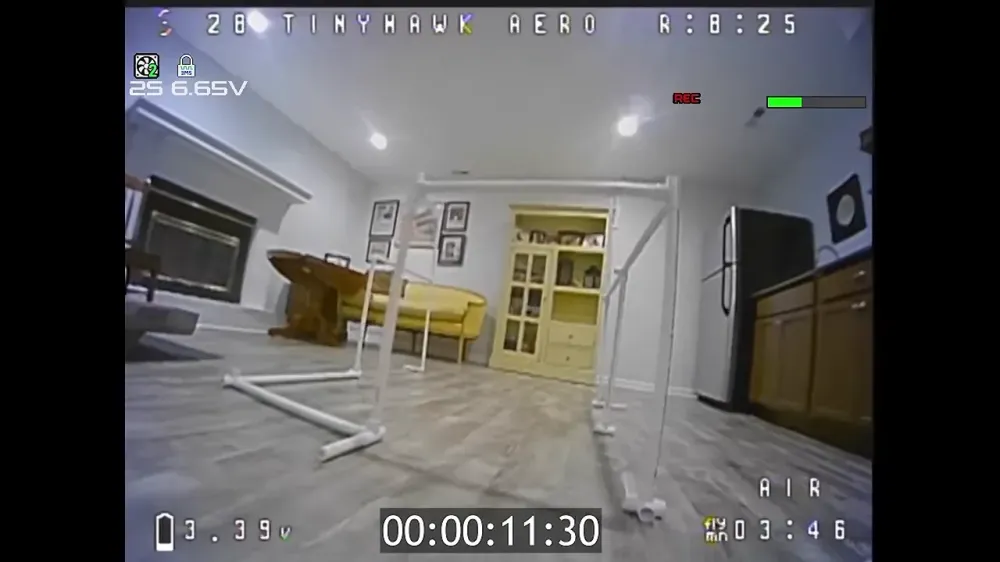
Caption: The first practice run combines a visible course with an added timecode, without a dedicated lap timer.
In the first run, Burns concentrates on smoothness rather than outright speed and reports 34.21 seconds. The second run, using the P1, starts with a bump off the floor and finishes at a reported 31.30 seconds.
- Same course: Both demonstrations use the same track and location.
- Different aircraft: The second run changes to the P1, so this is not a controlled before-and-after training test.
- Unofficial results: Burns says he had not necessarily submitted either run.
- Training priority: He is trying to fly smoothly and record a time, not demonstrate maximum pace.
“Smooth is fast” is his working approach. For this sort of practice, the useful takeaway is to complete the course with control before making speed the whole exercise. A time gives that repetition a reference point; it does not explain every change between attempts.
Will beginners just lose to the fastest pilots?
RaceGow uses tiers intended to group pilots with others near their skill level. Burns explains that everyone starts together on track one, then previous-track times inform placement for later tracks.
- Initial track: Pilots begin on common ground.
- Later tracks: Submitted times help determine tier placement.
- Progress: You can compare performance within a more relevant skill group.
- Missed week: Burns says missing a track does not get you removed.
- Last place: Finishing last does not stop you continuing to submit.
This removes two common excuses: “I am not fast enough” and “I cannot commit every week”. Burns plans to participate as time permits around running his channel and normal life, rather than pretending everyone has a spare racing season hidden behind the sofa.
Bench Note: A tier system cannot fly the quad for you. It can make the comparison less absurd than measuring your early attempts against somebody whose thumbs appear to have their own flight controller.
There are also prizes that do not depend on being fastest. Burns’s channel sponsors random prizes, and he describes weekly submissions and involvement in the livestreams as part of that opportunity; the official prize list and conditions remain the reference.
The livestreams serve another purpose: exchanging tips and getting involved with the FPV community. For pilots still building their routine, our essential FPV pilot tips sit alongside that practice with advice on preparation, checks and steady learning.
How do you get started with RaceGow?
Start with the event rules, not the shopping basket. Burns identifies Dan, known as Skittles FPV, as the organiser and directs pilots to register through the RaceGow links.
- Check the current event: Read the rules, available classes, track plans and deadlines.
- Choose your route: Physical aircraft and course, or an official simulator track.
- Sort the evidence: Confirm how timing, recording and submission work for that route.
- Build to the plan: Buy the listed fittings or use suitable materials already available.
- Fly for control: Establish a smooth run, record it and submit as required.
- Keep participating: A missed track or a poor placing is not a reason to abandon the season.
Date note: Burns cites 11 October as the deadline approaching during his season-six announcement. That is a deadline from that announcement, not a standing annual date; check the current schedule before planning an entry.
The argument is refreshingly unglamorous: make practice easy to repeat, give it a measurable target and keep doing it. No new silicon required. Just a course, a recording method and some time on the sticks.
FAQ
Is RaceGow 6 free to enter?
Burns describes the event as free to participate in. A physical course still needs materials: his examples were about $7 for 12 feet of PVC and $2–$4 per connector, with local prices varying.
Can I enter RaceGow without a Tiny Whoop?
Burns describes support for aircraft beyond traditional Whoops, including larger quads on scaled tracks, and simulator participation. Check the current class and scaling rules before choosing an aircraft or building the course.
Do I need DVR goggles for a RaceGow submission?
Real-world entries need recording, but Burns understands that a mobile phone recording can qualify without a DVR. The official rules determine what evidence is accepted, so verify that before relying on a particular setup.
Does RaceGow support DJI and HDZero?
Burns explicitly names DJI and HDZero as options for HD flying. Video-system flexibility does not remove the need to follow the track, class and recording requirements.
Are RaceGow simulator times submitted automatically?
Burns understands that results on official simulator tracks are recorded automatically. Confirm the process for the simulator and class you intend to use; he does not provide a simulator setup procedure.
Can I keep entering RaceGow after missing a track?
Yes, Burns says a missed track or last-place finish does not get you kicked out. You can continue participating and submitting later tracks.