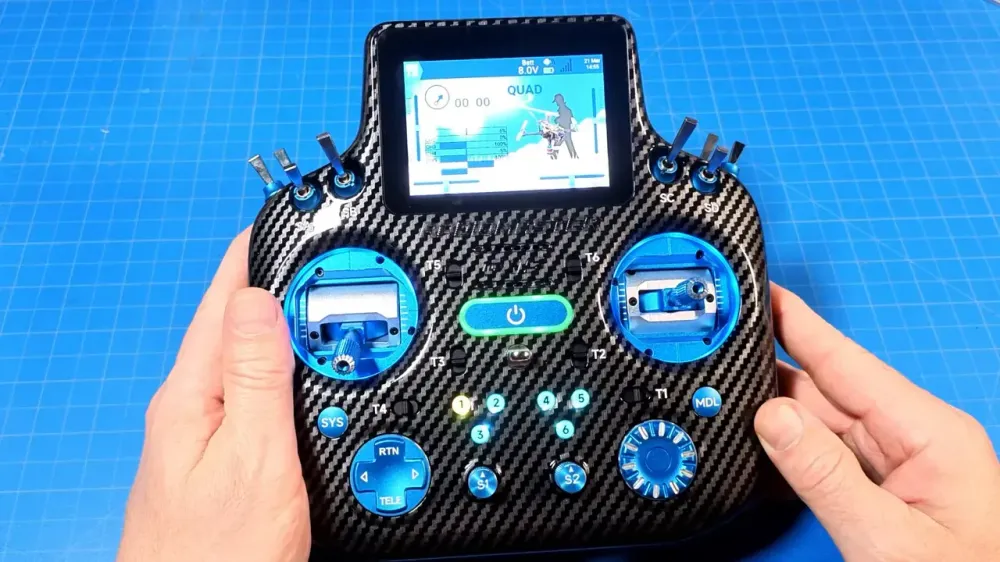

The RadioMaster GX15 is not merely a line-of-sight transmitter wearing an FPV costume. It is a full-size ExpressLRS radio with a logical screen position, a serious switch count, and one specification that buyers should notice before admiring the blue CNC jewellery.
TLDR: What you actually need to know
- Radio link power: The internal ExpressLRS transmitter tops out at 250 mW, including the GX15 Max.
- Best for: Pilots wanting a full-size radio with a touchscreen above the sticks, lots of switches, and configurable RGB lighting.
- Avoid if: A built-in 1 W ExpressLRS transmitter is non-negotiable and an external module feels like buying a workaround.
- Battery: The radio does not include batteries for retail buyers, but its large rear bay accepts two 18650 cells or larger packs.
- Controls: The GX15 has a momentary switch, two-position switches, several three-position switches, buttons, dials, trims, and front-adjustable gimbals.
- Verdict: It is a solid full-size RadioMaster option, though the 250 mW ceiling is the feature most likely to settle the purchase.
Is the RadioMaster GX15 really a line-of-sight radio?
No. The GX15 works perfectly well as an FPV radio, and its raised display is arguably more logical than the label suggests.
The screen sits above the control interface rather than between the gimbals. That arrangement has led some people to treat it as a line-of-sight layout. Yet screens normally sit above hands on desktop computers, laptops, and phones. The logic is not especially revolutionary, but neither is putting a monitor where a monitor normally goes.
For FPV flying, the display is not the primary point of attention anyway. It is there for setup, telemetry, model selection, and those inevitable moments when a radio menu becomes a small administrative event.
A higher screen can also reduce the amount of neck folding needed while changing settings. It is not a dramatic advantage, but it is a sensible one.
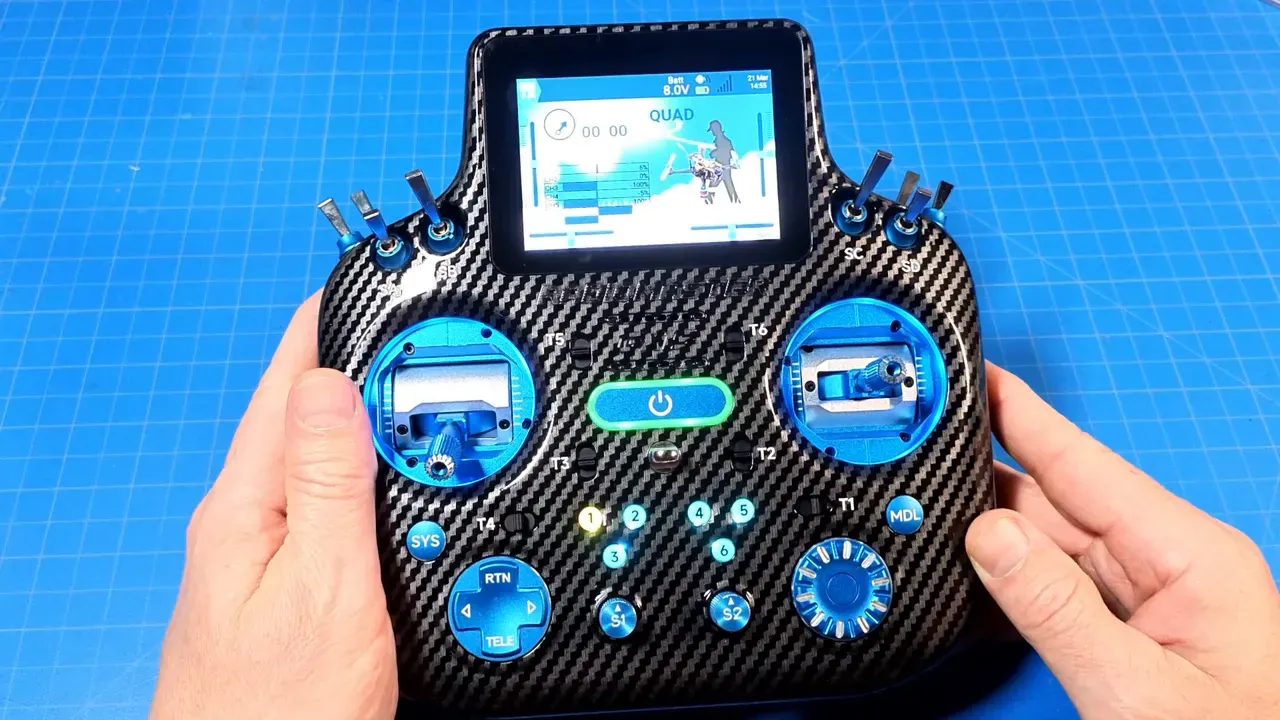
Practical takeaway: Do not reject the GX15 as line-of-sight only. Choose it based on its full-size shape, control layout, and radio-power limit instead.
What is the RadioMaster GX15 ExpressLRS power limit?
The RadioMaster GX15 internal ExpressLRS transmitter is specified to reach 250 mW, not 1 W.
This applies to both the standard GX15 and the GX15 Max. The radio settings demonstration shows 250 mW as the maximum selectable transmitter power. It is a hard purchasing detail, not a decorative footnote placed behind the carbon-effect plastic.
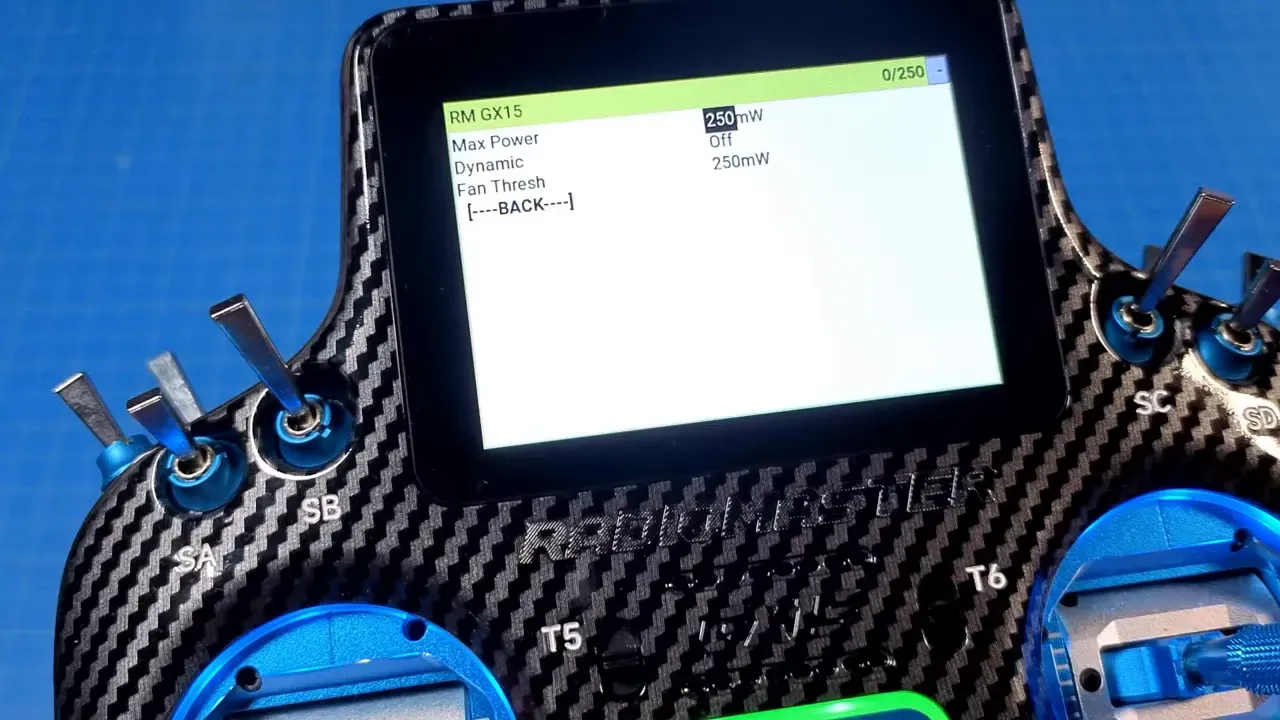
Some radios may present higher settings after flashing, but a menu position is not proof of delivered output. The GX15 is specified as a 250 mW radio, so buyers requiring more should treat that as the baseline.
The rear full-size JR bay offers an escape route. An external RadioMaster module could provide the higher ExpressLRS output some pilots want, including a 1 W option. It also supports other module-based projects.
That said, fitting an external module to obtain the power expected from a new transmitter is a fair reason to choose another radio. Nobody buys a shiny new control system hoping to begin with an accessory requirement.
Practical takeaway: The GX15 makes sense for pilots comfortable with 250 mW. Buy with a module plan only if the added size, cost, and setup are acceptable.
What does the RadioMaster GX15 Max add?
The GX15 Max adds blue accents, CNC metal gimbals, metal hardware, RGB lighting, a metal rear handle, and leather-like grips.
The all-metal CNC gimbals are described as very smooth. Their tension and travel adjustments are accessible from the front, which saves owners from treating a basic gimbal adjustment as a small disassembly project.
The Max styling is obvious. Blue hardware surrounds the gimbals and appears across the switches and controls. The power button, trim regions, and other accents join the same visual committee.
The radio also includes configurable RGB LEDs. These can run colours and effects such as blue, green, flow patterns, and other options. It is bling, certainly, but it is configurable bling, which is how modern electronics justify blinking at people.
How do you configure GX15 RGB LEDs?
The GX15 RGB LEDs can be assigned through a global function in the radio settings.
Create a global function using the plus button, set its function to RGB LEDs, then select the desired effect or colour. The demonstration assigns the first global function to RGB LEDs and changes the selected effect from blue to flow, then green.
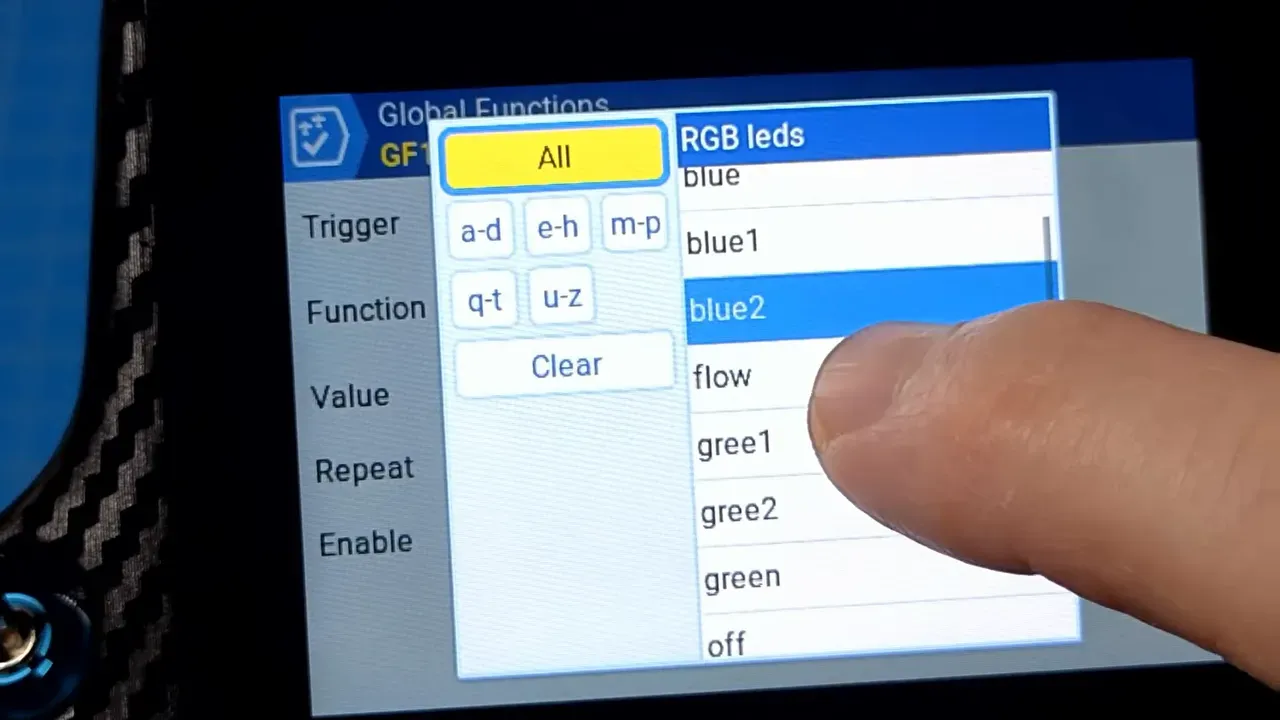
The screen also provides colourisation and theme settings. These are EdgeTX features rather than GX15-only magic, but the touchscreen makes the menus more approachable than navigating every setting through buttons.
The illuminated control buttons can show different colours when functions are activated. Their exact colour options are not fully stated in the demonstration.
Practical takeaway: RGB lighting is optional, configurable, and separate from radio performance. Set it once, then return to flying rather than auditioning every light pattern at the field.
How many switches and controls does the RadioMaster GX15 have?
The GX15 has a generous control selection, including a momentary switch, a two-position switch, multiple three-position switches, trims, buttons, and rotary dials.
That is normal territory for a larger transmitter, but it matters for pilots who need dedicated arm, flight-mode, beeper, turtle-mode, rescue, or accessory controls. The presenter is particularly keen on switches for rapid disarming after crashes, especially with micro quads where a fast disarm can save an ESC or motor.
The lower rotary controls can navigate menus along with the button dial. They may also suit live adjustment work, such as assigning Betaflight PID settings to a dial. Their distance from the sticks is worth considering before building an entire tuning routine around mid-flight adjustment.
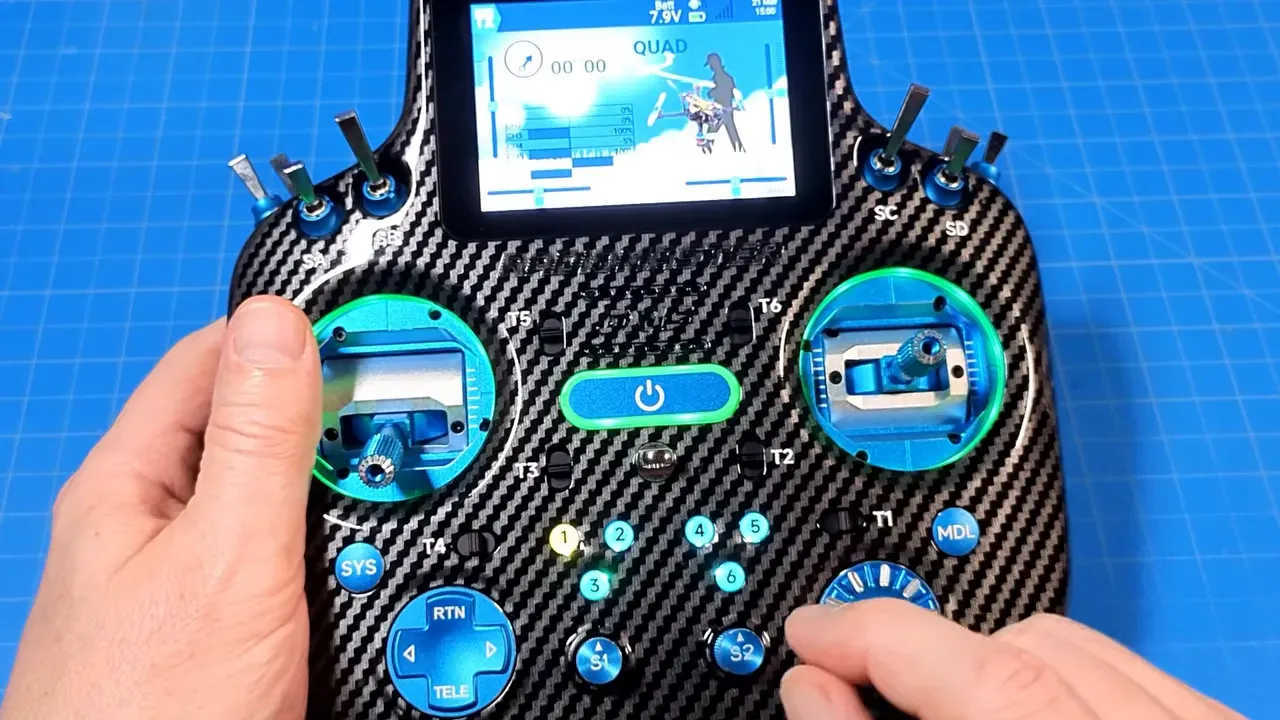
Long switches are easy to reach, but they are more exposed than short switches or buttons. A case is not glamorous, but neither is replacing a snapped switch after something lands on the transmitter.
Practical takeaway: The GX15 is a strong fit for pilots who genuinely use switches. Treat the taller switch hardware with the usual packing discipline.
What battery does the RadioMaster GX15 use?
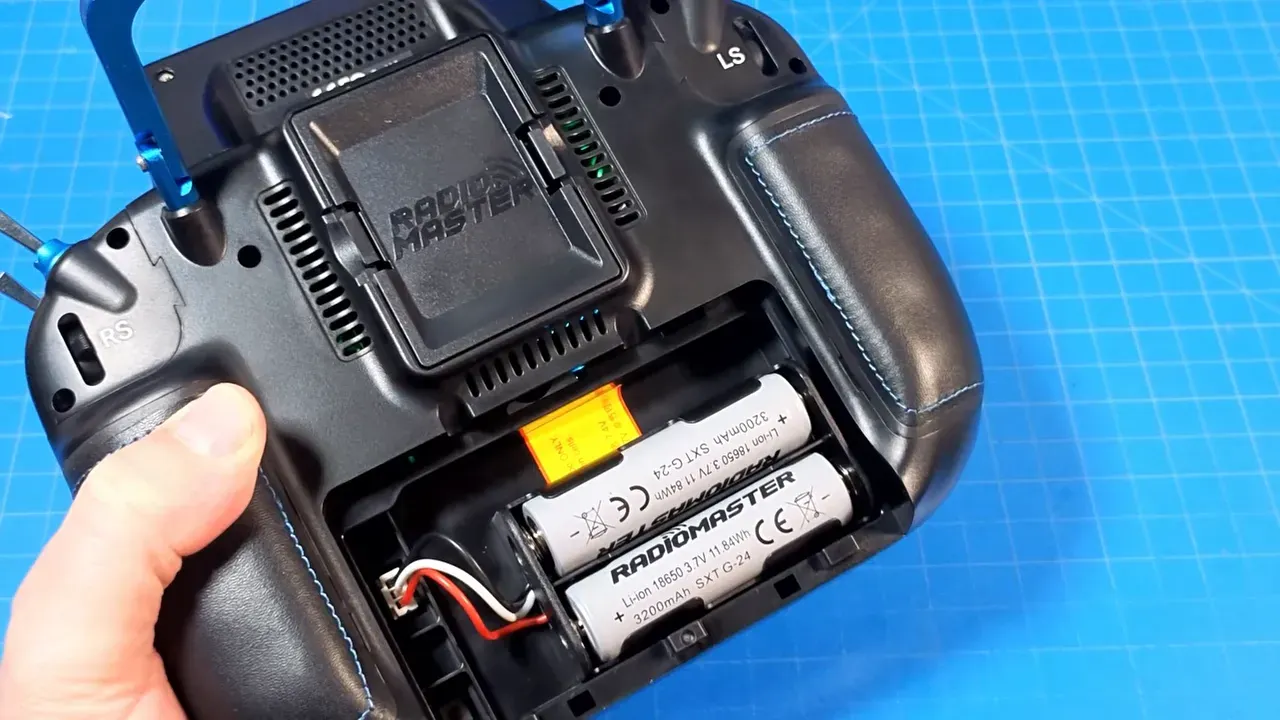
The GX15 has a large rear battery bay and can run from two 18650 cells or compatible larger battery packs.
The demonstrated unit runs on two-cell batteries. Retail radios do not include cells, so buyers need to budget for a suitable battery solution. That is common enough in RC radio land, where batteries remain mysteriously absent from items that need electricity.
The demonstration identifies compatible 5,000 mAh and 6,200 mAh packs as options for the battery bay. Exact pack compatibility should be checked before purchase, particularly where connector type and physical dimensions differ.
The top edge includes USB-C for charging, simulator connection, and flashing. It also has an audio port and trainer port. The rear includes vents, and vents also appear behind the screen.
Practical takeaway: Plan the battery purchase alongside the transmitter. A radio with a large bay is useful only after something appropriately charged is inside it.
Can the RadioMaster GX15 use an external module?
Yes. The GX15 has a full-size JR module bay on the rear, allowing an external module to be fitted.
The primary reason discussed is higher-power ExpressLRS operation. A module can provide the 1 W output unavailable from the GX15’s internal 250 mW transmitter. The module bay may also be useful for other radio projects.
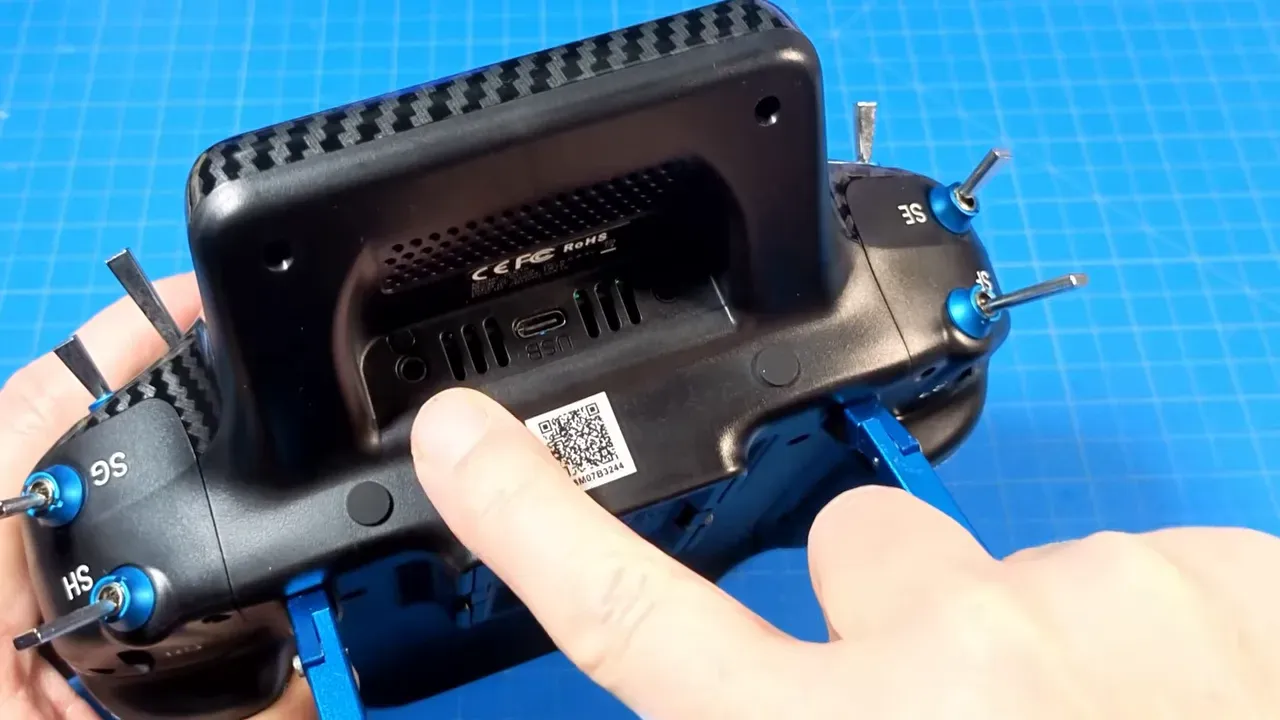
The radio also has rear accessory mounting areas and brass-threaded holes on the bottom. These appear intended for tray mounting, which may appeal to fixed-wing or helicopter pilots who prefer that style of support.
Practical takeaway: The JR bay adds flexibility, but it does not change the internal radio’s 250 mW specification.
Is the RadioMaster GX15 screen layout better for FPV?
The screen-above-sticks layout is a sensible option for FPV, but it is a preference rather than a universal victory.
The GX15 touchscreen is positioned high enough to be glanced at without looking down between the gimbals. This mirrors the way computer monitors and phone displays sit above the hands operating them.
Its large bezel is more contentious. Compared with the RadioMaster Boxer R1 mentioned in the demonstration, the GX15 has noticeably more unused border around its display. The bezel does not stop the radio functioning, obviously, but it makes the screen area feel less efficient than it could be.
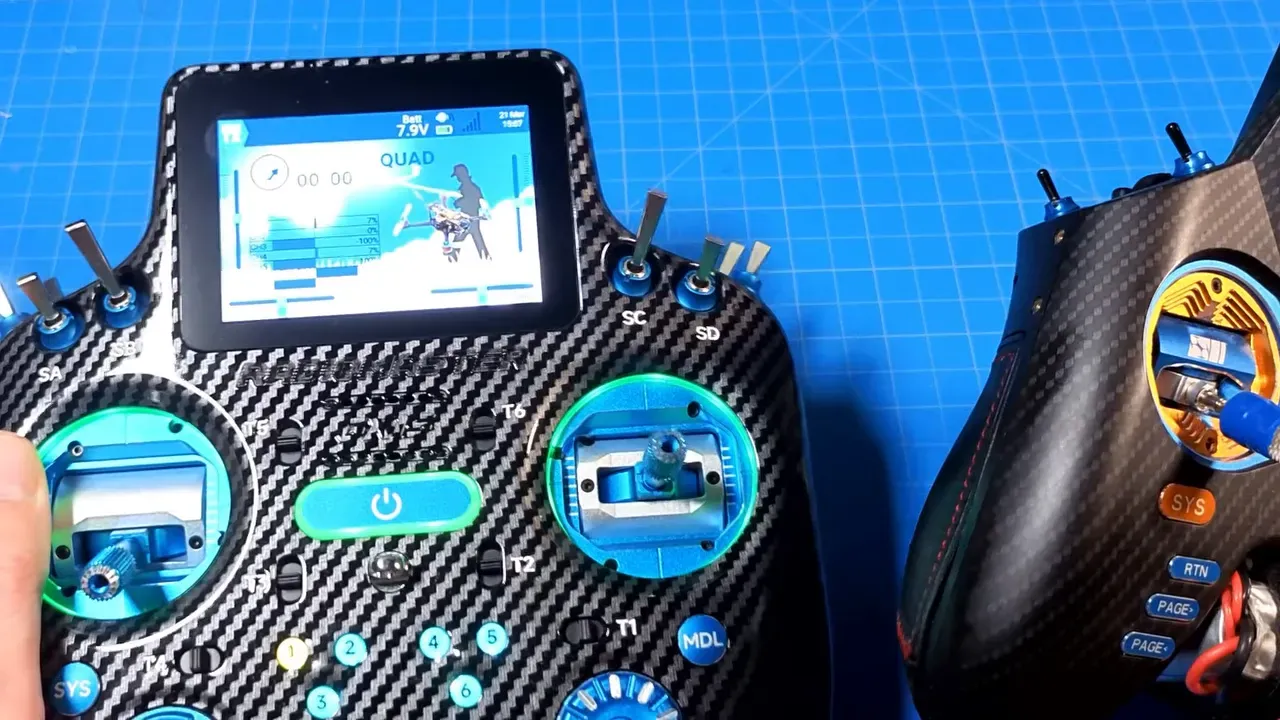
Practical takeaway: Pick the GX15 if the raised screen looks comfortable for setup work. Do not buy it solely for the touchscreen, because most FPV flying does not involve poking radio menus.
What should a RadioMaster Zorro 2 improve?
A future RadioMaster Zorro 2 should retain the original Zorro footprint and side angle, while gaining better battery capacity.
The presenter’s current daily driver is a Pyro Drone Edition Zorro with CNC gimbals. The compact width, depth, and stick angle are considered important enough to preserve. The main weakness is battery capacity, which currently requires a battery strapped beneath the radio.
A better design could extend the body downward to create room for a conventional larger internal battery. It would alter the gamepad-like shape slightly, but could retain much of the existing aesthetic while fixing the more practical complaint.
A colour touchscreen would be acceptable if it remains efficient. A smaller non-touch colour screen, or even a smaller monochrome screen, would also be acceptable. For compact FPV use, a giant display is seen as overkill.
Switches should remain. Rapid arming and disarming is valuable for micro-quad pilots, particularly after a crash. Buttons, dials, and sliders are less important in this use case.
Practical takeaway: A worthwhile Zorro 2 would prioritise battery capacity and retained switch access over screen size or cosmetic redesign.
What evidence is missing from this GX15 review?
This assessment is based on the supplied product demonstration and its on-screen settings. No independent range test, output-power measurement, long-term durability test, retail pricing, firmware version, or workshop repair data was provided.
The 250 mW limit is presented as the radio specification and shown in its settings. It should not be confused with a measured RF output test.
Buyers who need detailed range, latency, firmware, or long-term reliability data should seek independent bench testing and current manufacturer documentation before ordering.
For ExpressLRS setup and fault diagnosis, our guide to common ExpressLRS errors and fixes covers the usual wiring, binding, channel-order, and configuration traps. New ExpressLRS users may also prefer this beginner’s guide to binding ExpressLRS receivers before blaming the radio, the receiver, or atmospheric betrayal.
FAQ
Is the RadioMaster GX15 internal ExpressLRS transmitter 1 W?
No. The GX15 internal ExpressLRS transmitter is specified to top out at 250 mW. A full-size JR bay allows an external module if higher transmitter power is needed.
Does the RadioMaster GX15 include batteries?
No. Retail buyers should supply their own batteries. The demonstration shows two 18650 cells and mentions compatible 5,000 mAh and 6,200 mAh battery packs.
Can the RadioMaster GX15 charge through USB-C?
The USB-C port is identified for charging, simulator use, and flashing. Battery choice and charging setup should still be checked against current RadioMaster documentation.
How do I change the RadioMaster GX15 LED colours?
Create a Global Function and assign RGB LEDs as its function. The effect or colour can then be selected through the radio settings, including options such as blue, green, and flow effects.
Is the RadioMaster GX15 good for FPV drones?
Yes, if its full-size format and 250 mW internal ExpressLRS limit suit the intended flying. The raised touchscreen does not prevent FPV use, while the substantial switch count suits pilots who assign several flight functions.
Can the RadioMaster GX15 use a JR module?
Yes. The rear full-size JR bay supports an external module. This is the practical upgrade path for pilots who want more ExpressLRS output power than the internal 250 mW system provides.